

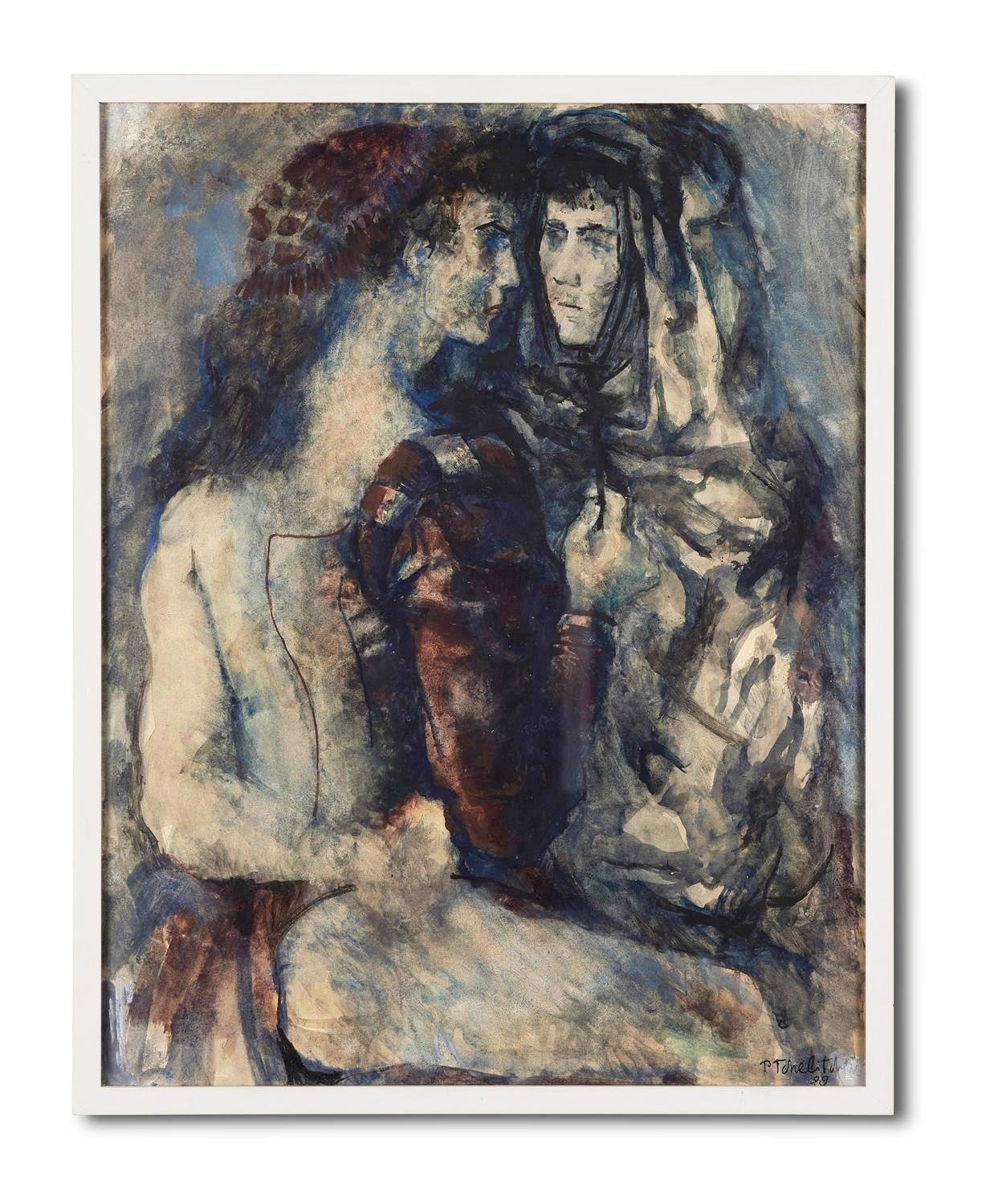




P.TCHELITCHEW Self-portrait. Signed and dated 1930 lower right Brush and sepia ink on paper. 17 x 10". Provenance: Sotheby's. Sale LN 5638 London, October 25 1995. Lot 96 .

P.TCHELITCHEW EROTIC PHANTASY ink and wash on paper sight: 10½ h × 15½ w in (27 × 39 cm) Provenance: Robert Miller Gallery, New York; Property from the Collection of Seymour Stein ; Rago arts auction NJ sale 2/16/2020 lot 206. Sale LN 5638 London, October 25 1995. Lot 96 .
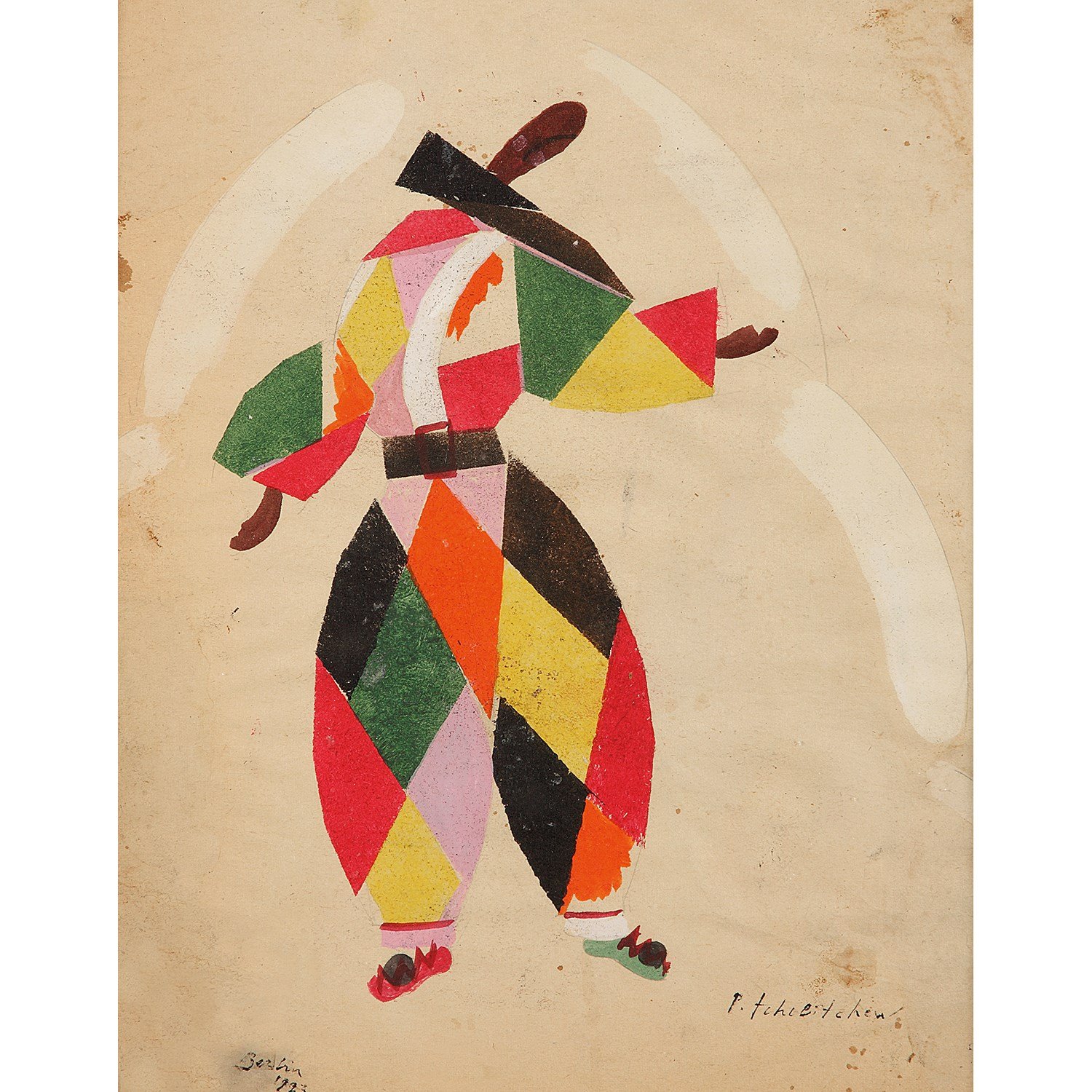
Projet de Costume d’Arlequin, 1923 Gouache sur papier Située Berlin et datée en bas à gauche Signée en bas à droite Gouache on paper; situated and dated lower left; signed lower right 34 x 27cm - 13 3/8 x 10 5/8 in.

Costume design for a geisha. Kiev 1920. W/c on paper, signed low right in Cyrillic and dated. Exhibited: Alex Zachary Gallery New York November 25 - December 23, 2011 Another variant of the costume is reproduced in HUDOJNIKI RUSSKOGO TEATRA 1880-1930. Sobranie Lobanovyh-Rostovskih.Katalog-Reso ne. J. Bowlt. Iskusstvo, Moscow 1994, #867 p.272.

Costume design for a dancer with a scarf. Enterprise Zimin, Stambul 1920-21. W/c on paper, signed low left in Cyrillic. Exhibited: Alex Zachary Gallery New York November 25 - December 23, 2011 Another variant of the costume is reproduced in HUDOJNIKI RUSSKOGO TEATRA 1880-1930. Sobranie Lobanovyh-Rostovskih.Katalog-Reson e. J. Bowlt. Iskusstvo, Moscow 1994, #872 p.273

” Three women on a swing” Backdrop design for “Tschastuschki” – a divertisment in Der Blaue Vogel (Russisch-Deutscher Cabaret Theater, Berlin) Zweites Programm, april 1922 (the program is attached), with stamped signature on verso, gouache on shaped paper, 32x37 cm. Exhibited: London, The Alpine Club. W!, arranged by Richard Nathanson, Pavel Tchelitchew: A Collection of Fifty-Four Theatre Designs c. 1919-1923, 13-22 December 1976 (illustrated in the catalog as #12 on p. 14). Provenance: Richard Nathanson; purchased from the above by the family of the previous owner in January 1977 for GBP 230 (a copy of the invoice is attached); Bonhams, London 5 June 2013 The Russian Sale lot 36 (illustrated in the catalog)

Costume design for warrior in The Sacrifice of Atoraga, 1922 (ballet, music by Glasounov, choreography by Boris Romanov, presented by Russische Romantische Theater, Berlin) with stamped signature on verso, gouache on paper,50.5x 32.5 cm. Exhibited: London, The Alpine Club. W!, arranged by Richard Nathanson, Pavel Tchelitchew: A Collection of Fifty-Four Theatre Designs c. 1919-1923, 13-22 December 1976 (illustrated in the catalog as #19 on p. 17). Bibliography: Russkoe Isskustvo XX Vek/ Issledovaniya i Publikatsii 3, Moscow, Nauka, 2009, back cover, illustrated. Provenance: Impressionists and modern paintings, drawings and sculpture, Christie’s, London 24 May 1990, lot 206; Bonhams, London 5 June 2013 The Russian Sale lot 52 (illustrated in the catalog).
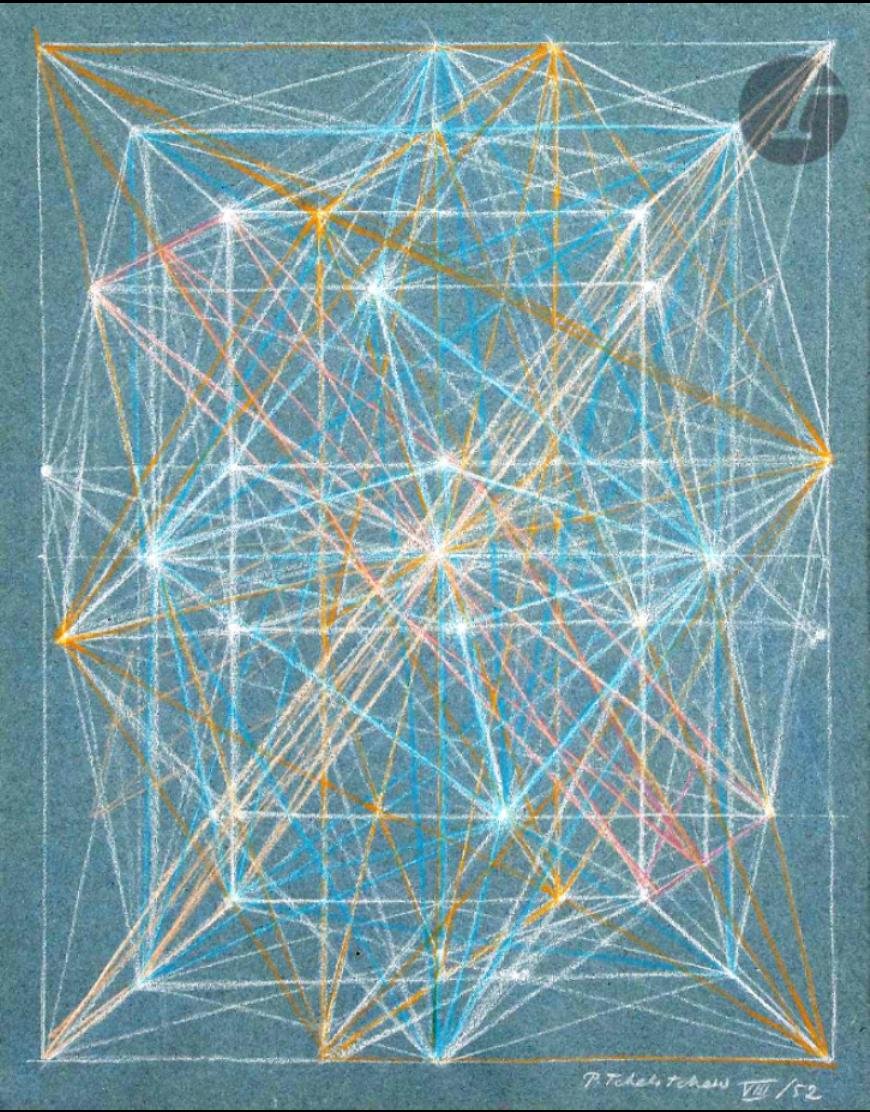
Composition 1952 Pastel and chalk on blue paper. Signed, dated and numbered lower right Provenance: Sotheby's London, Russian sale 06/01/2020 lot 63; Ader, Paris sale 5 Nov 2021 lot 203

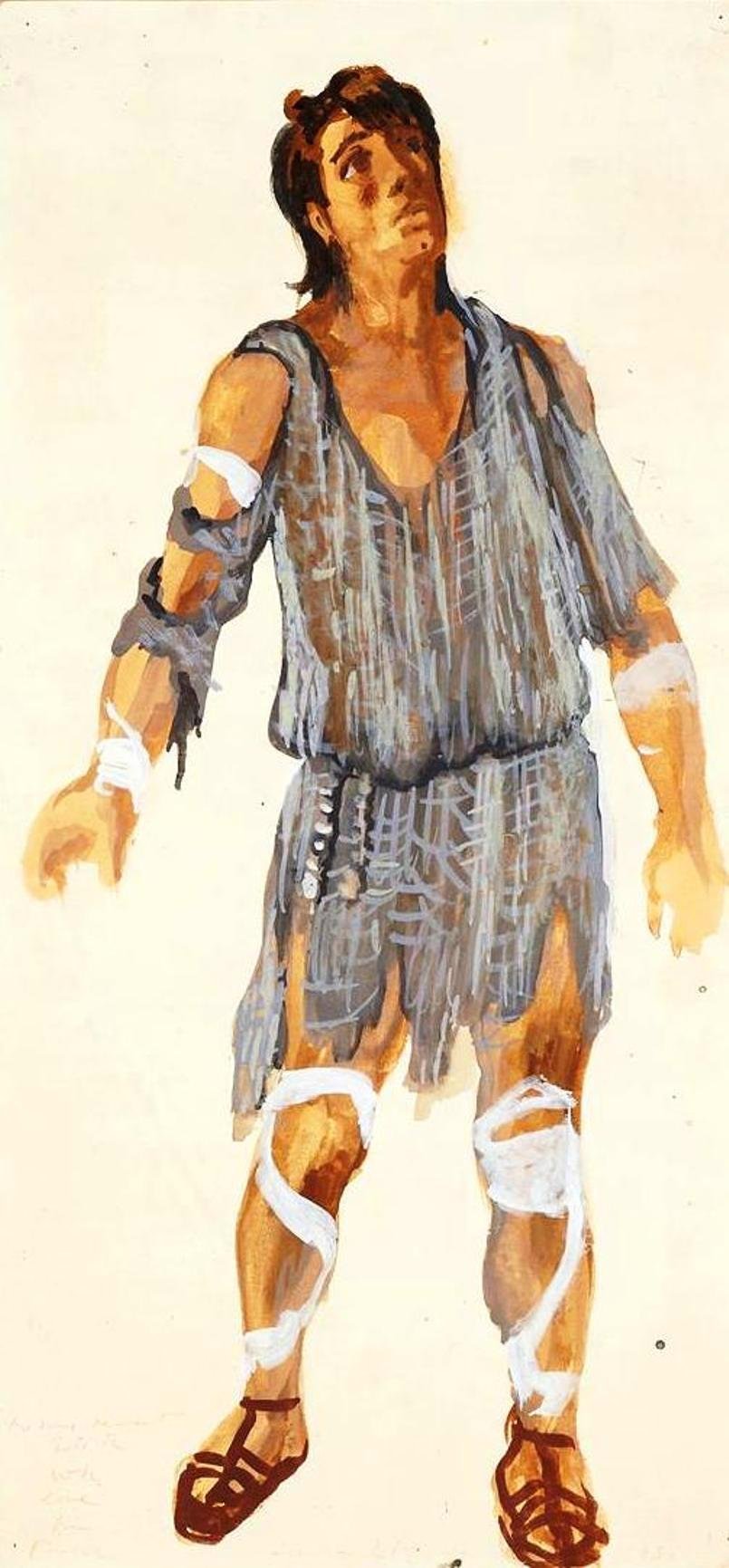
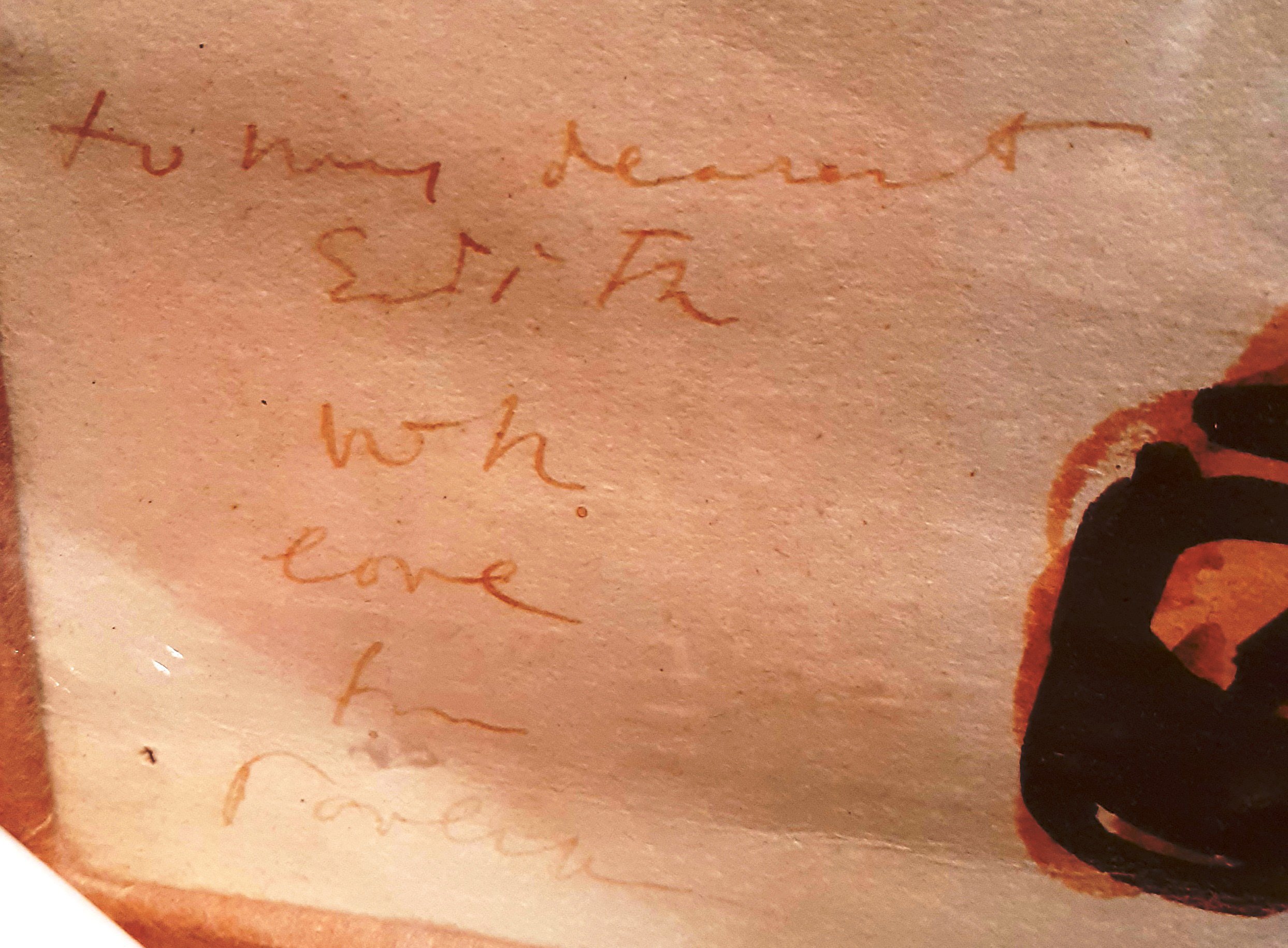
Costume design for 'Nobilissima Visione' ballet Gouache Signed and dedicated "To my dearest Edith, with love from Pavel (lower left), indistinctly dated London 2(?) July 1938" (lower centre-right) 52 x 25cm Provenance: Gifted by the artist to Dame Edith Sitwell DBE (1887-1964), at 2 Carlyle Square, London Thence by descent at Weston Hall; Drewwattes UK sale Nov 17 2021 lot 367

Costume design for Hermann in divertissement " Pique Dame" at Der Blaue Vogel (Russisch-Deutscher Cabaret Theater, Berlin) Zweites Programm, April 1922 (the program is attached) with stamped signature and title on verso, gouache on paper, 22x30 cm., Provenance: Alexander Gallery Bristol UK (label on the back); John Nicholson auction UK 04/07/2013 lot 1066 In original American Arts and Crafts Forest ornamentation decorated hand carved and gesso frame


Luxembourg Gardens in Paris. gouache on dark paper. Verso with signature stamp and numbered: «169». sheet Size 49.7 × 32.2 cm. C. 1927 Framed. Provenance:Collection Mr. and Mrs. N. Magnus, 1972; Gallery Richard Nathanson, London (label on the reverse); sale «Z26/2», Modern Kunst, Moderne Graphik, Zeitgenössische Kunst, Zürich, Friday, June 19, 2009 Lot 3213 ; sale Schuler Auctionen, Zurich 22.09.2017 lot 3232


Soldiers Toasting, "Bon Voyage!" Mixed technique (Pen and ink, gouache and color pencils, 1924. 585x425 mm; 23x16 3/4 inches. Signed "Pavel Tchelitcheff", dated "October 1, 1924"and inscribed "Paris" in ink, lower right recto. Drawing is imitating a mural showing defects of underlying wall around the main image.

Costume design for a dancer with chains. Enterprise Zimin, Stambul 1920-21. W/c on paper, signed low left in Cyrillic. Exhibited: Alex Zachary Gallery New York November 25 - December 23, 2011 Another variant of the costume is reproduced in HUDOJNIKI RUSSKOGO TEATRA 1880-1930. Sobranie Lobanovyh-Rostovskih.Katalog-Reson e. J. Bowlt. Iskusstvo, Moscow 1994, #878 p.274

Nude in Hammock. Watercolor on paper, signed low right, 15x21 inches [1928-1930]. Hammock was one of the favorite artist’s accessories in that period – see Green Venus, 1928, Penelope, 1930 (both illustrated in TCHELITCHEW Gallery of Modern Art. 20.03-19.04.1964. NY. #5 and #11 respectively), and Spanish Dancer 1930 (illustrated in TCHELITCHEW, Paintings. Drawings. Text by Thrall Soby. Museum of Modern Art, NY. 1942, #28). Provenance: Robert L.B. Tobin collection

Study for Green Venus, 1928 Unsigned, identified on a label from Richard Nathanson, London, affixed to the backing. Gouache on paper, sheet size 19 11/16 x 25 3/4 in. (50.0 x 65.4 cm), framed. Exhibited: A Selection of Paintings, Gouaches and Drawings arranged by Richard Nathanson. The Alpine Club, London 03.18-03.30.1974 - described and illustrated in the catalog under #38. N.B. The present work relates to an oil of the same title and year- currently in the Metropolitan Museum of Art collection. Provenance: Collection of A.B. Dawson, esquire; Richard Nathanson gallery, London (label on the back); Skinner Auction: American & European Works of Art - 2750B Boston September 19, 2014 lot 655


Orpheus Signed and dated "P.Tchelitchew '31" l.r. Sepia ink, pen and brush on paper, sheet size 17 1/2 x 22 in. (44.4 x 55.9 cm), framed. Bibliography: Tchelitchew Drawings. Text by L. Kirstein. D/J Bittner and Company, 1947 (illustrated); description p. 15. Condition: Tears to folding creases, handling creases, acid burn, toning. Provenance: Durlacher Brothers, New York City; Skinner Auction: American & European Works of Art - 2750B Boston September 19, 2014 lot 606


Two imaginary landscapes:
"Lion" and "Mice"
mixed media on paper
21x26 cm signed and dated 1939 ("Mice") and 1940 ("Lion")
Provenance: Edward Thorp Gallery New York


Etudes d’hommes- recto, etudes de femmes- verso. Signed, pen and Indian ink. c. 1930.


Seated Spahi, gouache and watercolour on paper, stamped with artist’s studio stamp on reverse 64x49 cm [1930] .Provenance: estate of the artist; Gallery Richard Nathancon (label on the back); collection Ms. Huizinga(label on the back); Sothebys, Sale: L11112 lot 016. EXHIBITED: Durlacher Bros New York, 5.1 – 31.1.1948, #12 of the catalog; A Selection of Paintings, Gouaches and Drawings arranged by Richard Nathanson. The Alpine Club, London 04.24-05.13.1972 #24 of the catalog, illustrated.
[“In the autumn 1930 Tchelitchew was visited by George Girard, a friend serving with the Spahi regiment. Inspired with this visit and the exotic spahi costume, this work forms part of the series of studies for the two oil paintings “Seated Spahi” and “Sleeping Spahi” which Tchelitchew completed in the winter of 1931”. A Selection of Paintings, Gouaches and Drawings arranged by Richard Nathanson. The Alpine Club, London 04.24-05.13.1972]


Leaves Children from Hide & Seek Ink and Watercolor on paper, Signed and dated 1939 lower left, 18x12 inches (47x31cm). Expositions: Purchase NY Neuberger Museum (label on the back); Richard Feigen Gallery (label on thje back); Zeitlin & ver Brugge, Los Angeles (label on the back) Provenance: Julien Levy collection; Tajan sale Pari “Hommage a Julien Levy” 5-7 October 2004, lot 43 (illustrated in the catalog); Phillips London sale 15 February 2013, lot 250

Project for the costume of the Queen of the Night in Mozart's "Magic Flute" signed 'P Tchelitchew' (lower right) sepia and India ink on paper 11 ½ x 17 in. (29.2 x 43.2 cm.) Executed in 1942. Provenance : Durlacher Brothers, New York; Property From The Holdings Of The Ford Foundation; Christie's Sale 12199 Living with Art 2 - 3 December 2016, New York, Rockefeller Center lot 74 ["Between 1928 and 1942, Tchelitchew worked closely with George Balanchine, Igor Stravinsky, and others in the theatre-and-dance world. In 1942, Tchelitchew was invited by the editors of ARTnews to create a work illustrating how the artist would present The Queen of The Night, scene from Mozart’s opera, The Magic Flute. This particular drawing was published with the caption, “Drawn especially for ART News by

Pavel Tchelitchew.”The editors considered Tchelitchew the “the most fantastic of the moderns, he seemed to us perhaps the only available man equipped both in stage knowledge and imagination to deal with the most fragile and fanciful of Mozarts . . .” After a brief introduction, the editors quote Tchelitchew’s “description of the costume”: “The Queen of The Night in Mozart’s Magic Flute is Queen Maria Theresa of Austria who is portrayed in the opera as a malevolent, raging spirit who tries to prevent Tamino the prince from ascending the Throne. In the scene of her great aria she appears in an ‘Egyptian mirage’. The scene represents the big ballroom of the palace of Schonbrunn . . . The Queen of The Night steps forth atop a projection with her court of nine planets. She is dressed in dark indigo—blue taffeta embroidered with jet and sequins. Her wings of a night-moth are embroidered with the signs of the constellations in small sequins or diamonds, the stars in large shining stones. Her dress is embroidered in the same way with signs of the Zodiac. The Planets who hold her baldaquin-like wings are dressed in much darker taffeta decorated with jet. On their pale silver-blue chiffon turbans they carry black statues’ heads. The Planets—Mercury, Mars, Venus, and the rest—are covered with precious stones. The underskirt of the Queen’s costume represents an evening sky just after sunset and is pale blue-grey-mauve satin covered with chiffon on which cloud effects are painted. She walks atop a continuous projection of a cascade behind a glass balustrade . . . “ 1942 was the last year Tchelitchew created décor for the stage and dance theatre. If you look closely, you can find small figures (people) trapped in her wings. These metamorphic “interior images” were a dominate theme in Tchelitchew’s drawings and paintings at this time, especially in his major painting, HIDE AND SEEK, exhibited in 1942, in his retrospective at The Museum of Modern Art. This drawing is a fine example of Tchelitchew’s stage art. Bibliography: What The Metropolitan Opera Might Do: An Ideal for the “Magic Flute.” Tchelitchew: Project for the Magic Flute. ART News. Vol. XLI. No. 3. March 15-31. 1942. Pg 8." http://www.christies.com/lotfinder/drawings-watercolors/pavel-tchelitchew-project-for-the-costume-of-6041734-details.aspx?from=searchresults&intObjectID=6041734&sid=1d41710e-2182-4d37-a523-91988c6bd3c2 ]
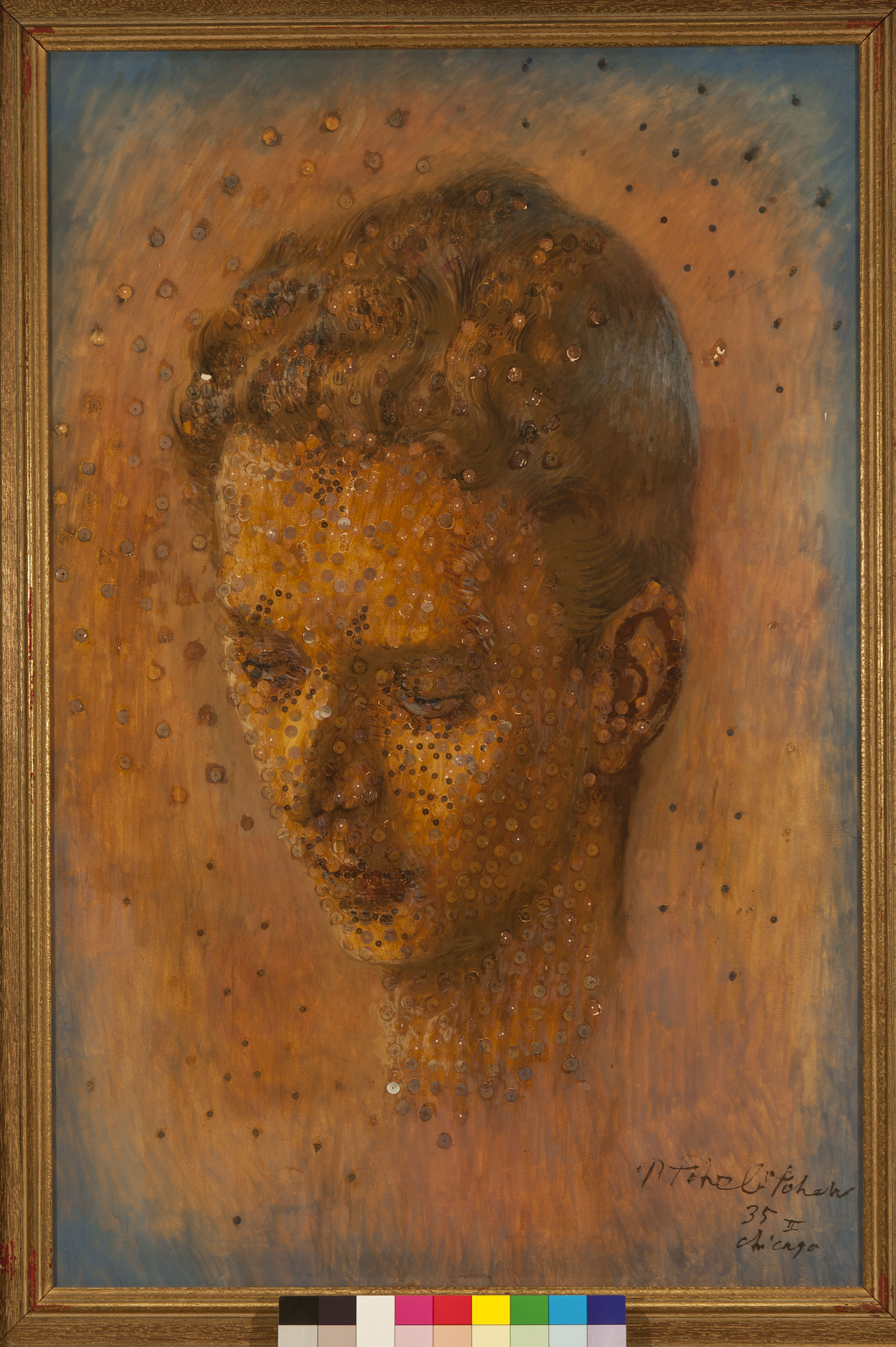
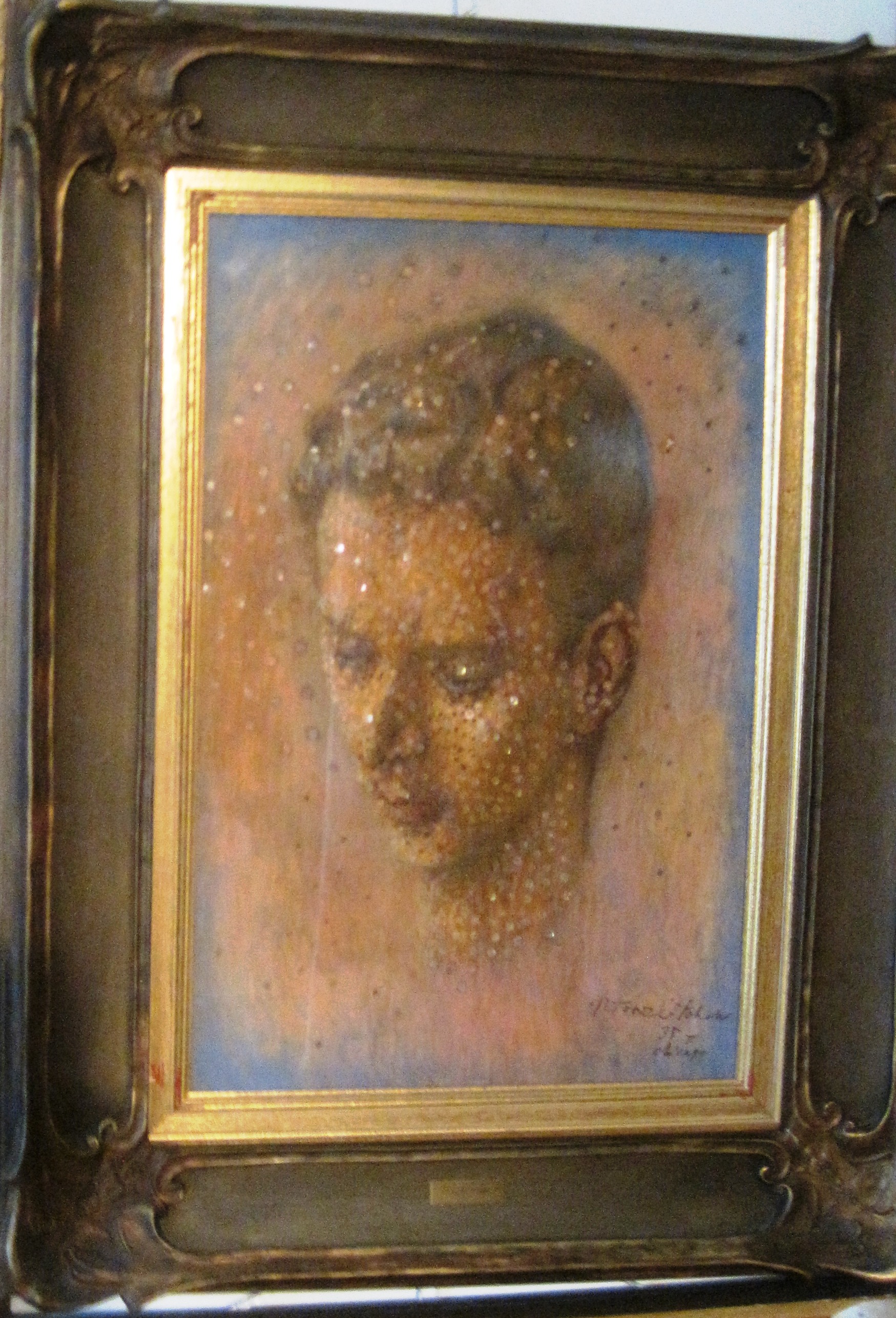
Spangled Head [Portrait of Charles Henry Ford under snow], watercolor, gouache encrusted with sequins on illustration board, 30x20 in., signed P. Tchelitchew and inscribed 35 II/Chicago (lower right), also inscribed Spangled / Head / P Tchelitchew 1935 / Chicago / to store until my return / in Nov 1949 (verso). Bibliography: “A Time to Gather… Russian Art From Foreign Private collections”, State Russian Museum, Saint-Petersburg, Palace Editions,2008, illustrated on p.22; Art+Auction, March 2008, illustrated on p. 83.In original American beginning of 20th century Art Nouveau style gesso and hand-carved parcel gilded cassette frame by A. E. Schneider, Seattle (label on the back). Compare: there exists one more work by Tchelitchew exploiting the same collage technique with sequins in portrait of Helena Rubinstein - Paintings. Drawings. Text by Thrall Soby. Museum of Modern Art, NY. 1942, #38, p.63

[Penis adventures]. Numbered 805 in red on the verso. India ink on paper. c. 1930 . 11 x 9".

Nude woman pierced by an arrow and two smaller studies of her on the same sheet. Dated 6.1.35 and dedicated in Russian: “Zosya [Kochanski] to remember from Pavel, embrace Pavlik, New York." India ink, pen and brush on Japan watermarked paper laid on board. 11 x 8".

Four expressive heads on artist’s palette. Dated 1937 NYC and dedicated in Russian to Zosya {Kochanski] for Christmas and New Year. Ink, chalk and gouache on paper collaged on blue paper, 10 x 13".

Nude from behind, oil/canvas , signed up right, 95x90cm c 1940 Painting is imitating a mural showing defects of underlying wall around the main image.

PORTRAIT OF MY FATHER Signed P. Tchelitchew (lower right) Oil on canvas 19 by 24 1/8 in. 48.3 by 61.3 cm Painted in 1939. In original gulided frame with silk velvet insert chosen by the artist. PROVENANCE Lincoln Kirstein, New York (acquired directly from the artist); SOTHEBY’S New york Sale 06 May 2010 lot 381. EXHIBITIONS: New York, Museum of Modern Art, Tchelitchew, 1942, no. 50, illustrated in the Catalog; Dramatic choice, The theater collects Nov4-Dec1 1950, The Buffalo Fine Arts Academy, Albright Art Gallery, Buffalo, New York, #63 in the catalog; New York, Gallery of Modern Art, Pavel Tchelitchew, 1964, no. 23, illustrated in the Catalog; illustrated in Русское Искусство magazine Moscow, 2015 v4 p 87.. LITERATURE Lincoln Kirstein, Tchelitchev, Santa Fe, 1994, no. 54, illustrated in color, n.p.; Alexander Kuznetsov "Pavel Tchelitchew Metamorphoses" Arnoldshe Art Publishers, 2012, Stuttgart, illustrated #1 80 p210. CATALOGUE NOTE (Sotheby’s) Born into an
aristocratic Russian family in 1898, Pavel Tchelitchev, after fleeing the Russian Revolution, arrived in Paris in 1923. There he saw the paintings of Picasso, Gris and Braque, and met luminaries such as Gertrude Stein and Charles Henri Ford, the Surrealist poet who would become his lifelong partner. In 1934, Tchelitchev and Ford moved to New York, and in 1942 The Museum of Modern Art gave Tchelitchev his first solo exhibition, which included the present work. Painted in 1939 at the height of his artistic career, Portrait of My Father is a highly personal work, which reflects the salient themes of his earlier pictures, and foreshadows what would become the artist's most celebrated canvas, Hide and Seek (Cache-cache), painted the following year, now in the collection of the Museum of Modern Art in New York. In 1938 Tchelitchev was given a studio in an 18th century farmhouse designed for him by Alice de Lamar, an amateur architect who lived in Weston, Connecticut. Here the artist became captivated by the rural landscape of New England. He made numerous highly detailed studies of the trees, leaves and hills, and gradually, images of children and animals began to emerge. The idea of metamorphosis was one that preoccupied Tchelitechev a decade earlier in Paris, encouraged in part by the Surrealists. Inspired by their interest in ambiguous images, as well as by the double-picture postcards that were popular in Russia when he was a child, Tchelitchev produced a number of works in which figures were concealed within figures, and images were compiled together to create a larger composition. In Portrait of My Father, the snow covered hills become a tiger, an image of the artist's father inspired, in part, by the snowy landscape of his childhood in Russia. James Thrall Soby writes, "Tchelitchew...has always considered that metamorphosis must contribute to fixed structure, that it must be used as a kind of interior magic, creating its own mystery and awe but never becoming the dominant illusion. He wishes the observer to be able to go back and forth easily between hidden images and the composition which contains them, never losing one in seeing the other" (Tchelitchew, New York, 1942, p. 19). The present work was given by the artist to Lincoln Kirstein, the collector and founder of the American Ballet, where it hung in his home until his death. Unusually in Tchelitchew's oeuvre there exist two paintings with the same title, Portrait of my Father. The other version is a powerful anthropomorphic allegory, an evocative rendering of Tchelitchew's early surroundings. The central figures of the children are surrounded by the forest, a symbol for Tchelitchew's father, while all around human faces and animals emerge from the wintry Russian landscape of his childhood. Images of the artist's father are embedded in the leopard and polar bear in the background, and in the cat and the boulder in the foreground, which provides several profiles. As Tchelitchew himself recalled, 'In early 1939, I made an oil painting of a snow landscape with children, the landscape itself being a composition of polar bear and leopard in combat. I perceived a great resemblance between landscapes and snowy hills and animals.' It has been suggested that many of the motifs of the work evolved from studies and sketches that Tchelitchew was creating for his monumental masterpiece, and one of his most celebrated works, Hide-and-Seek, 1940-1942, in the collection of the Museum of Modern Art, New York.

HEAD oil on canvas variously labeled (on the reverse) 32 by 23 1/2 in., 81.5 by 59.5 cm c 1949 PROVENANCE: Property from the Collection of Ruth Ford and Charles Henri Ford; Sale Sotheby's Arcade, New York, February 24, 1995, lot 104; Sale IMPORTANT RUSSIAN ART Sotheby New York, November 4, 2010, lot 37, illustrated. Bibliography: Alexander Kuznetsov "Pavel Tchelitchew Metamorphoses" Arnoldshe Art Publishers, 2012, Stuttgart, illustrated #235 p261. {That portrait evidently represents a new direction started in 1949 of the artist works named by himself "Interior landscapes" - another example is illustrated to the right and lower as items #TCHOA7d, #TCHOA4d}


THREE HEADS (PORTRAIT OF RENÉ CREVEL) signed P. Tchelitchew (lower right) and dated [19]26; variously inscribed and labeled (on the stretcher) oil on canvas MEASUREMENTS 18 3/4 by 14 1/2 in., 48 by 37 cm PROVENANCE: Property from the Collection of Ruth Ford and Charles Henri Ford; Collection Gertrude Stein; Galerie de Beaune, Paris; Estate of Ralph Church, Santa Barbara; Sale: Sotheby Parke Bernet, New York, January 20, 1973, lot 87; Estate of Richard van Every; Sale: Sotheby Parke Bernet, New York, December 14, 1976, lot 33, illustrated; Sale IMPORTANT RUSSIAN ART Sotheby New York, November 4, 2010, lot 35, illustrated. EXHIBITED: Galerie Druet, Paris February 22- March 5 1926 #48 in the catalog; Syracuse, Everson Museum of Art, Pavel Tchelitchew, September-October 1983; "The Steins Collect: Matisse, Picasso, and the Parisian Avant-Gard,."San Francisco Museum of Modern Art, the Grand Palais in Paris, and The Metropolitan Museum of Art in New York in 2011 and 2012,#433 in the exhibition catalogue, illustrated as plate 190. Bibliography: Alexander Kuznetsov "Pavel Tchelitchew Metamorphoses" Arnoldshe Art Publishers, 2012, Stuttgart, illustrated #27 p76. In “Tchelitchew Paintings. Drawings” Museum of Modern Art, NY 1942 Thrall Soby wrote: In the fall of 1925 Tchelitchew had attempted his own solution of a problem which had engrossed abstract painters of the older generation, particularly Picasso, and which had supplied one of the most persistent themes in 20th century paintings: the simultaneous presentation of several different aspects of the human head and figure… His conscience was on the side of psychological interpretation rather than abstract design, and in his portrait of Rene Crevel painted late in 1925 (collection Miss Gertrude Stein, Paris) he had shown three highly recognizable aspects of the poet’s head – from behind, in profile and full-face – by presenting them in successive planes, using a minimum of distortion except in the common line of the hair which serves for two of the heads. Some years later Salvador Dali was to adopt the latter device in double portraits of himself and his wife.” (Gertrude Stein wrote of the artist and that painting in her Autobiography of Alice B. Toklas “The young Russian [sic!] was interesting. He was painting ,so he said, colour that was no colour, he was painting blue pictures and he was painting three heads in one. Picasso had been drawing three heads in one. Soon the Russian was painting three figures in one.” See also an interview by Charles Henry Ford, connecting these three persons together – Gertrude Stein, Pave Tchelitchew and Rene Crevel http://www.english.illinois.edu/maps/poets/a_f/ford/interviews.htm) Another (graphical) variant of that portrait had been published in Crevel René “L’Esprit contre la Raison”, Les Cahier du Sud, Marseille, 1927 (illustrated underneath the main one). (René Crevel (10 August 1900 – 18 June 1935) was a French writer involved with the surrealist movement. Crevel was born in Paris to a family of Parisian bourgeoisie. He had a traumatic religious upbringing. At the age of fourteen, during a difficult stage of his life, his father committed suicide by hanging himself. Crevel studied English at the University of Paris. He met André Breton and joined the surrealist movement in 1921, from which he would be excluded in October 1923 due to Crevel's homosexuality and Breton's belief that the movement had been corrupted. During this period, Crevel wrote novels such as Mon corps et moi ("My Body and Me"). In 1926, he was diagnosed with tuberculosis which made him start using morphine. The 1929 exile of Léon Trotsky persuaded him to rejoin the surrealists. Remaining faithful to André Breton, he struggled to bring communists and surrealists closer together. Much of Crevel's work deals with his inner turmoil at being bisexual. Crevel killed himself by turning on the gas on his kitchen stove the night of 18 June 1935, several weeks before his 35th birthday. There were at least two direct reasons: (1) There was a conflict between Breton and Ilya Ehrenburg during the first "International Congress of Writers for the Defense of Culture" which opened in Paris in June 1935. Breton, who like all fellow surrealists, had been insulted by Ehrenburg in a pamphlet which said – among other things – that surrealists were pederasts, slapped Ehrenburg several times on the street, which led to surrealists being expelled from the Congress. Crevel, who according to Salvador Dalí, was "the only serious communist among surrealists" [ (and was facing more and more solitude as the real face of Soviet socialism started to occur), spent a whole day trying to persuade the other delegates to allow surrealists back, but he was not successful and left the Congress at 11pm, totally exhausted. (2) Crevel reportedly had learned that he suffered from renal tuberculosis right upon leaving the Congress (Claude Courtot). He left a note which read "Please cremate my body. Loathing." It should be remembered that when André Breton included the question "Suicide: Is It a Solution?" in the first issue of La Révolution surréaliste in 1925, Crevel was one of those who answered "Yes". He wrote "It is most probably the most correct and most ultimate solution.") In original XVII sentury hand carved and gild frame in a shape of double-headed eagle (provenance for the frame Alcala Subastas auction sale Madrid Spain Dec 3 2013 lot 944 - bears a label by JIPTA (Board of Seizure and Protection of Artistic Treasure) - a body created by Spanish Republican government in July 23, 1936 to control the assets and effects of the uncontrolled burning of temples during the first moments of the franco uprising
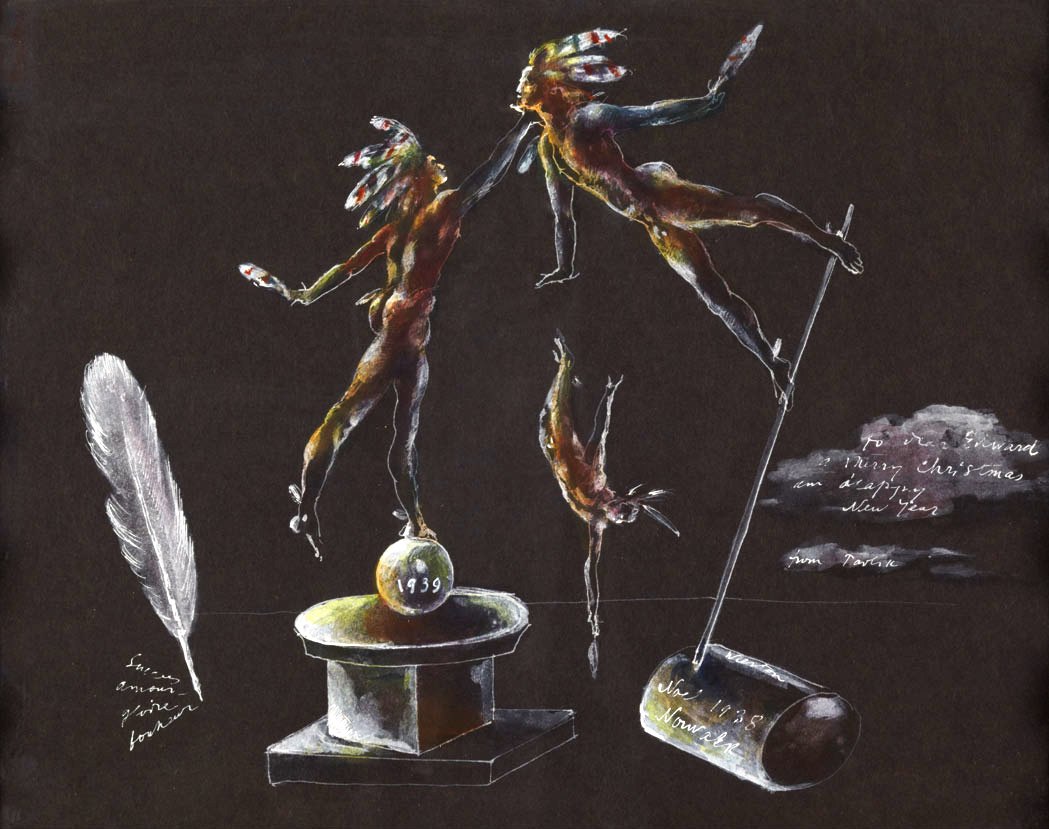
Three Indian Acrobats, 1938/1939 Inscribed To...Edward/a Merry Christmas. and Happy/New Year/from Pavlik(cl), Weston/Nov 1938/Norwalk (lr), sucess/amour/glory/forever (ll) and dated 1939 on the ball at center White ink and watercolor on black paper 12 7/8 x 16 1/8 inches Provenance: Edward James Collection; Sold Christie's New York, 6 Oct., 1988, lot 98;Estate of Lee B. Anderson; Doyle New York, sale 19.09.2012 lot 1167 [that drawing also in 1939 was used as a leading theme for design of a Steuben glass vase by Tchelitchew - see an image to the right].


Head of a horse. Signed in latin l.r., oil on canvas, 38.5x46.5 cm Preparatory draft for 1930 painting "Fallen Rider" (see catalog of 1942 MOMA exhibition - illusytation 22 on p.49) Provenance: Collection of Stephen Tennant (1906-1987), acquired by previous owner from David Gill Gallery, London, circa 1988-1989; Sotheby's London Russian Sale 26 Nov 2013 lot 389 (illustrated in the catalog). [The youngest son of a Scottish peer, Stephen Tennant was said to be the brightest of the "Bright Young Things", the bohemian set of the 1920s and 1930s, and is thought to have been the inspiration behind Sebastian Flyte in Waugh's "Brideshead Revisited". Tennant met Tchelitchew in the late 1920s and was the subject of a number of his drawings. The young aristocrat had himself studied at the Stade School of Art before turning to ballet where he was taught by Leonide Massine]

Portrait of Tamara Toumanova, prominent American ballerina and actress Signed with gallery stamp on the reverse. Provenance: Katherine Viviano Gallery, NYC c. 1950; Palm Beach Modern Auctions 24 Nov 2012 lot 131 Dimensions: 21"h, 15"w; 29"h, 23.25"w frame. Illustrated in [https://americangallery20th.wordpress.com/2015/04/08/pavel-tchelitchew-1898-1957/ Two portraits of Toumanova were also made by A. Iacovleff. Bibliography: compare with an other variant of her portrait dated 1938 at Tajan sale “Homage a Julien Levy, Paris 5-7 October 2004, lot 414 (illustrated)

Scull. Dated 1955 and signed up right Mixed media on paper, 10 x 15"


DAVID AND GOLIATH – initial draft for the painting (shown on the right image)with the same title.Signed P. Tchelitchew (lower right), signed Pavlik, dated 1942 and inscribed to Ruth a memory of David and Goliath (lower left) Pen, ink and wash on paper 20 by 26.7 cm. Provenance: PROPERTY FROM THE COLLECTION OF RUTH FORD AND CHARLES HENRI FORD Sothebys Sale: N08747 | Location: New York Auction Dates: Session 2: Wed, 16 Mar 11 lot 216

TCHAIKOWSKI Signed P. Tchelitchew and dated 1949 VIII (lower left) Pastel and pencil on paper 30.5 by 22.2 cm. PROVENANCE Durlacher Bros., New York The Estate of Barbara Wescott, Rosemont, New Jersey Sale: Sotheby's New York, June 23, 1982, lot 146; Sothebys Sale: N08747 New York Wed, 16 Mar 2011 lot 185 EXHIBITED New York, Galler y of Modern Art, Pavel Tchelitchew, 1964, no. 301 Bibliography: Alexander Kuznetsov "Pavel Tchelitchew Metamorphoses" Arnoldshe Art Publishers, 2012, Stuttgart, illustrated #234 p261. { Barbara Harrison [later Wescott] and Monroe Wheeler established a fine press Harrison of Paris in Paris in 1930 . It published A Calendar of Saints for Unbelievers by Glenway Wescott, with illustrations by Pavel Tchelitchew in 1932 }

COSTUME DESIGN FOR "ORPHEUS" Signed P. Tchelitchew and dated 36 (upper left) Ink, wash and gouache on paper 43.5 by 20.9 cm. Provenance: PROPERTY FROM THE COLLECTION OF RUTH FORD AND CHARLES HENRI FORD Sothebys Sale: N08747 | Location: New York Auction Dates: Wed, 16 Mar 11 LOT 198 Pavel Tchelitchew designed the scenery and costumes for Orpheus, an opera-ballet in two acts with music by Christoph Willibald van Gluck and choreography by George Balanchine. It was presented by the American Ballet Company at the Metropolitan Opera House in New York on May 22, 1936

PAIR OF THEATRICAL COSTUMES a) Costume design for the Shemakhan Princess. Gouache and gold paint on paper. Signed on the back, low right. Executed for Le Coq d'Or in 1923. 20 x 13". Exhibited: London, 1976. R. Nathanson, Alpine club-illustrated #51 on p. 33 of the catalog; Provenance: Sotheby’s. Dance, Theater, Opera and Music Hall. New York,23.04.1986. Lot 30; Christie's. South Kensington. Twentieth century art. 07.12.98. lot 62. Exhibited: “A World of Stage”, April- October2007, Tokyo Metropolitan Art Museum, Japan (illustrated in the catalog) b).Costume design for baba Babariha, Coq d’Or, signed in Russian, dated 1923 and inscribed to the writer Roman Gul “Милому Роману Гулю в воспоминание весны прошлого года Пав. Челищев 1923 VI”. Gouache, silver paint and collage on paper. 20 x 14". Provenance: Sotheby’s. European and American Paintings, drawings and sculpture. 06.28.2000 lo1 88. Exhibited: “A World of Stage”, April- October2007, Tokyo Metropolitan Art Museum, Japan (illustrated in the catalog)


Costume design for "Coq d’Or' 'Der Läufer' [Skorohod], titled 'Der Läufer' and inscribed 'III act' in Cyrillic on the lower margin; has a pencil draft of skorod's boot and signed with artist's stamp in Latin verso) gouache on paper 25 x 32cm (9 13/16 x 12 5/8in).Provenance Estate of the artist; With Richard Nathanson, London; BONHAMS The Russian Sale London, New Bond Street 8.6.16 Lot 49 Exhibition London, The Alpine Club, W1, arranged by Richard Nathanson, Pavel Tchelitchew 1898-1957: A Collection of Fifty-four Theatre Designs c. 1919-1923, 13-22 December, 1976, no. 44 Literature R. Nathanson, Pavel Tchelitchew 1898-1957: A Collection of Fifty-four Theatre Designs c. 1919-1923, The Alpine Club, London, 1976, exhibition catalogue, p.29, no. 44, illustrated


"Le Coq d'Or" in Berlin State Opera, act II. Étude de costume, 1923 Gouache et collages, signé et daté en bas à droite, en bas à gauche peu lisible: Berlin, en haut à gauche: II act Pavlik, 26,5x21 cm. Provenance: Galerie Raphaël Doueb; Sale Rossini Drouot Paris 5 avril 2016 TABLEAUX MODERNES ET SCULPTURES lot 141 [Tchelitchew's work in Berlin was enthusiastically received and widely influenced German stage designers during the mid-1920s. In 1923, he was commissioned by The Berlin State Opera to create sets and costumes for the Rimsky-Korsakov opera, Coq d'Or. Realistic stage designs and obvious settings never interested Tchelitchew, instead 'under his hand, the stage possessed no limitation to the visual exploitation of the theme, and [became] a universe in which any event could be given form.' (D. Windham, Dance Index, New York, 1944, p.4) The splendour of the designs for Coq d'Or fully attests to this. Coq d'Or was a folktale adapted into a political satire, the fable of 'the Tzar who forgot his kingdom and caroused with the ladies of the court while a Golden Cockerel kept watch for him over his troubled country.'(D. Windham,1944, p.7) Hence, all shapes and forms were rounded, eliminating the sharp edges of the heavy cubes present in Savonarola: '[...] everything becomes stuffed, upholstered and cushioned, with balls bursting out of bosoms and buttocks.' (L. Kirstein, Tchelitchew, Santa Fe, 1994, p.31) The genius of Tchelitchew was such that his geometry was able to convey the whole spectrum of emotions, proving to the public that imagination knows no limits.] https://www.bonhams.com/auctions/23222/lot/49/

Costume design for Le Coq d'Or in Berlin State Opera, act II. Gouache and silver paint on paper. Signed and dated 1923 low left. 24 x 18cm. Provenance: sale Tajan, Paris, 2.10.2014 lot 82
In original Italian 19th Century tortoise shell and ivory inlaid frame with cavetto sight, leaf decoration to the freeze with mask heads to the centers and eared corners, scotia, and cushion-molded back edge.


Fruit seller. Costume design for Le Coq d'Or in Berlin State Opera, act III. Gouache and pencil on paper. Signed and dated 1923 low left. 23 x 31 cm. Signed center left, inscribed "Berlin" low right and "#48 act (II)3" up left Provenance: sale Tajan, Paris, 18.11.2016 lot 326


Curtain (or backdrop) design for Le Coq d'Or in Berlin State Opera, act II Mixed media on paper. Signed low right and inscribed "Pavlik II act #19" low left; signed one more time in ink "P. Tchelitchew", inscribed "Berlin" and dated 1923 on the back. 25.5 x 19 cm. Bibliography: G.F. Kovalenko "Pavel Tchelitchew: Early Years" in Russkoe Isskustvo XX Vek/ Issledovaniya i Publikatsii 3, Moscow, Nauka, 2009, p. 109 - see comment on picture to the right. In original Art Nouveau Period w ood frame with flat profile, broader bottom and rounded top, with embossed metal decor, fern leaves, violet rays and cabochons reminiscent of the amethyst Provenance: sale Drouot Collin du Bocage, Paris, 21.11.2016 lot 66

Blaue Vogel 1922 costume, gouache and ink on paper laid on cardboard, 14x10 inches, 35x25cm,signed and dated [1}922 low right and inscribed "Berlin Blaue Vogel" left. Provenance: - Collection de Monsieur Journaux, Nîmes; sale Cornette de Saint Cyr, Drouot, Paris, 24.10.2015, lot 65.


Costume design for Dominico Savonarola, watercolor and goauche on card, 510 x 360 mm, Berlin, 1923, signed, titled and inscribed "Berlin" (lower right), further inscribed "Dominico / [name of the actor?]" (upper right). Provenance: Richard Nathanson Gallery, London; Bonhams, sale The Story of the 20th Century, lot 44 04/06/2014 Exhibited: London, The Alpine Club. W!, arranged by Richard Nathanson, Pavel Tchelitchew: A Collection of Fifty-Four Theatre Designs c. 1919-1923, 13-22 December 1976 (illustrated in the catalog as #30 on p. 22). Bibliography: G.F. Kovalenko "Pavel Tchelitchew: Early Years" in Russkoe Isskustvo XX Vek/ Issledovaniya i Publikatsii 3, Moscow, Nauka, 2009, illustrated on p. 105.

Costume design for Dominico Savonarola, stamped with the artist's signature on the reverse gouache, watercolour and silver paint over pencil on paper 30 by 22cm, 11 3/4 by 8 1/2 in. Executed circa 1920; Provenance: Estate of Alexandra Zaoussailoff, the artist's sister, Paris; Charles Spencer Theatre Gallery, London ; Sotheby's sale Russian Pictures 07 June 2016 London lot 92


Costume design for a seaman, signed and dated 1923 low left , inscribed (with a title?) BAR up left, also inscribed "Paolo fi" low left, bears printed numbers on collaged paper "847 3 4" up right and "800" low right, gouache, watercolor, black ink and collage over pencil on paper 29 by 22.5 cm Provenance: Cher Bébé Christian Bérard & Boris Kochno, Auction Art Remy Le Fur Paris 13.3.2017 lot 275

Decor for Savonarola, gouache and watercolor on paper 10 1/2" x 14 1/2" and the overall measurements are 16" x 19". It is signed "P. Tchelitchew" on the lower left, framed in a brown wood frame. Co mpare another smaller variant : · Christie's Sale 7772 Russian Art 1 - 2 December 2009 London, King StreetLot 457Exhibition catalogue, Pavel Tchelitchew, A Collection of Fifty-Four Theatre Designs, 1989-1957, The Alpine Club, London, 1976, no. 2, illustrated.
In original art nouveau wooden frame with ormolu decorations of the corners [Savonarola was produced at the Koeniggratzerstrasse Theatre, Berlin in 1922 and was based on Arthur Gobineau's The Renaissance.]


Savonarola. Preliminary sketch with strong Russian Constructivist elements for the production which was presented at Theater in der Königgrätzer Straße, Berlin, 1923; the final version of this set design was sold at Christie's London in 2016. Lacking in that final rendering was the presence of the titular friar, making this study an exceptionally important glimpse into Tchelitchew's intentions concerning scale. Graphite, gouache, and watercolor on paper. 210x305 mm; 8 1/4x12 inches, inlaid to 11 1/4x14 3/4-inch sheet. Signed with stamp "P. Tchelitchew" on verso. In original Art Nouveau hand carved and black lacquered frame


Label for Chateau Mouton-Rotschild wine showing a golden Mouton bearing on its neck a monogram BR (Baron Rotschild) and inserted into a typical Tchelitchew cage structure of the period with a splash of red wine in it ; lithograph signed and dated in stone “P.Tchelitchew [19]56”, 10x14 cm, bears mark “specimen” and inscription “Dessin inedit de Tchelitchew”. [ Exhibition in the Twelve Hall of the New Hermitage organized by the State Hermitage and Baron Philippe de Rothschild SA, the world-famous exporter of classified Bordeaux wines The exhibition, with more than 60 works , presents works by Pablo Picasso , Marc Chagall, Andy Warhol , Francis Bacon , Robert Mazaruella , Wassily Kandinsky , Jean Cocteau , and other great artists who created the label for the renowned French wine Mouton Rothschild. Of particular interest in the exhibition is the work of
renowned conceptualist Ilya Kabakov "Window" , which was created for the label Chateau Mouton Rothschild 2002 vintage His work - one of the most recent collection , which each year adds a new exhibit.The idea of the project belongs to the head of Baron Philippe de Rothschild SA Baroness Philippine de Rothschild . Since 1981 collection is exhibited in museums around the world , but in Russia , many of these works are presented for the first time . In 1924, Baron Philippe de Rothschild ( 1902-1988 ) to commemorate his first " bottling in the castle ," ordered the famous poster- artist Jean Carl Mouton label . In 1945 , in commemoration of the victory in World War II , Baron Philippe de Rothschild decided to cap the vintage label mark "V" from "Victoire" ( victory ) . This exceptional occasion spawned tradition , and since 1946 , every year new artist invited to create an original work for the label .Every year since 1945 , wine labels Chateau Mouton Rothschild creates the greatest masters of art of drawing, painting , printmaking , among which an important place is occupied by the representatives of Russian art school.Initially, Baron Philippe de Rothschild chose artists among his personal friends : Marie Lorenzen , Leonor Fini, Jean Cocteau. In 1955, the famous Georges Braque himself proposed to create an illustration for the vintage . It was followed by the biggest artists of our age : Salvador Dali , Joan Miro , Marc Chagall , Pablo Picasso, Pierre Soulages , Georg Baselitz , Francis Bacon , and now Ilya Kabakov . It creates a wonderful collection in which each year adds new work .In 1981, Baroness Philippine de Rothschild opened public access to these originals , creating a current exhibition . Exhibits are presented in glass cases , created by the designer Francis Lakloshem . Each piece individually isolated in a peculiar microcosm , where he is surrounded by a variety of exhibits: the vintage label , as well as photographs , clippings from print , and even some things donated by artists .With each new harvest this unusual collection grows and support , thus constantly updated unique dialogue between wine and art .The exhibition is presented in Europe ( London, Berlin, Brussels), in the United States, Canada , Japan and China , first exhibited in Russia. At the end of the State Hermitage Museum , the exhibition will be shown in Moscow , at the State Museum of Fine Arts. AS Pushkin , from 15 to 20 March 2005.

Portrait of Monroe Wheeler. Ink wash on paper, 9.5x12 inches, signed and dated (19)35 low right. [Wheeler, Monroe (1899-1988)Publisher, book designer, and museum director, Monroe Wheeler is perhaps best known today for his leading position in New York's artistic and gay communities of the 1950s and 1960s, with his partner of sixty-eight years, the writer Glenway Wescott. Tchelitchew has executed several his portraits].

Study for "Hide and Seek" Composition suréaliste Encre sur papier 13 x 23 cm Signed low right [1942] Provenance: lot 147 Collin Bocage Arts du XXe siècle 27 mai 2016

Couple Ink, wash, gouache and sand on paper Dimensions : Cm : 35,5 x 49,5 cm Inch : 14 x 19 1/2 in Probably a preliminary draft for 1926 painting "Nude in Space" - see catalog of MOMA 1942 exhibition - illustration 6 on p 38 Provenance: Richard Nathanson Gallery, London; Acquired directly from the above by the previous owner circa 1970s; Sotheby's London Russian sale June 3 2014 lot189

Study for The One Who Fell. Gouache on wove paper. 652x500 mm; 25 5/8x19 5/8 inches. With the artist's ink stamp signature, verso. Sold Sotheby's, New York, February 28, 1992, sale 1928, lot 30; Collection of Geoffrey Beene; Sotheby's, New York, September 23, 2005, sale 2345, lot 169; Swann gallery New York Sale 2418 Lot 110 Exhibited D.C. Moore Gallery, New York, inventory number "TCH 0061" with the label

TCHELITCHEW "Uncommon Thread", February 1953, pastel on colored paper, signed, dated, 12 x 10 inches Provenance: William Chambers, New York

"Lemon" Gouache and pastel on blue ‘Fabriano‘ laid paper (watermark) Italy, 1954 Signed and dated lower right ‘P. Tchelitchew 54’; signed one more time, inscribed with title "Le citro" and dated on the back. Sheet dimensions: 65.4 x 48.2 cm Frame dimensions: 82 x 64 cm Provenance: Auctionata sale Berlin 25.06.2015 lot 45; Drouot Richelieu, Cornette De Saints Cyr; Art Contemporain, Paris, Monday, October 18, 2010 lot 74; Galerie Rive Gauche, Paris (exhibited November 1956 and described in the catalog - see below). Bibliography: Alexander Kuznetsov "Pavel Tchelitchew Metamorphoses" Arnoldshe Art Publishers, 2012, Stuttgart, illustrated #248 p272. The painting was created in the late phase of the artist's creative life, in 1954, only three years before his death in Italy. He moved to Italy from the US in 1952, just after he had received the US citizenship. In that last period Tchelitchew had developed a very distinctive "neon" style. Taking everyday objects as well as portraits and dissolving their form in radial rings and lines, giving them a cosmic character. These works usually feature bright colors on a dark background.


P. Tchelitchew "Faces"
Mixed Media Signature: Center right Size: 9.25" x 5.25" Two exprompt portraits made by the artist on a concert program when he was visiting Chicago in 1934 and attending recital by Mary Garden
Provenance: J Levine Auction & Appraisal LLC April 30, 2017 Scottsdale, AZ, US, Lot 5982
[Mary Garden (20 February 1874 – 3 January 1967), was a Scottish operatic soprano with a substantial career in France and America in the first third of the 20th century Described as "the Sarah Bernhardt of opera", Garden was an exceptional actress as well as a talented singer She also gave lectures and recitals, mostly on the life and works of Claude Debussy, until 1949.]


Clown, lithograph #37/50 21x30 inches signed in stone low right

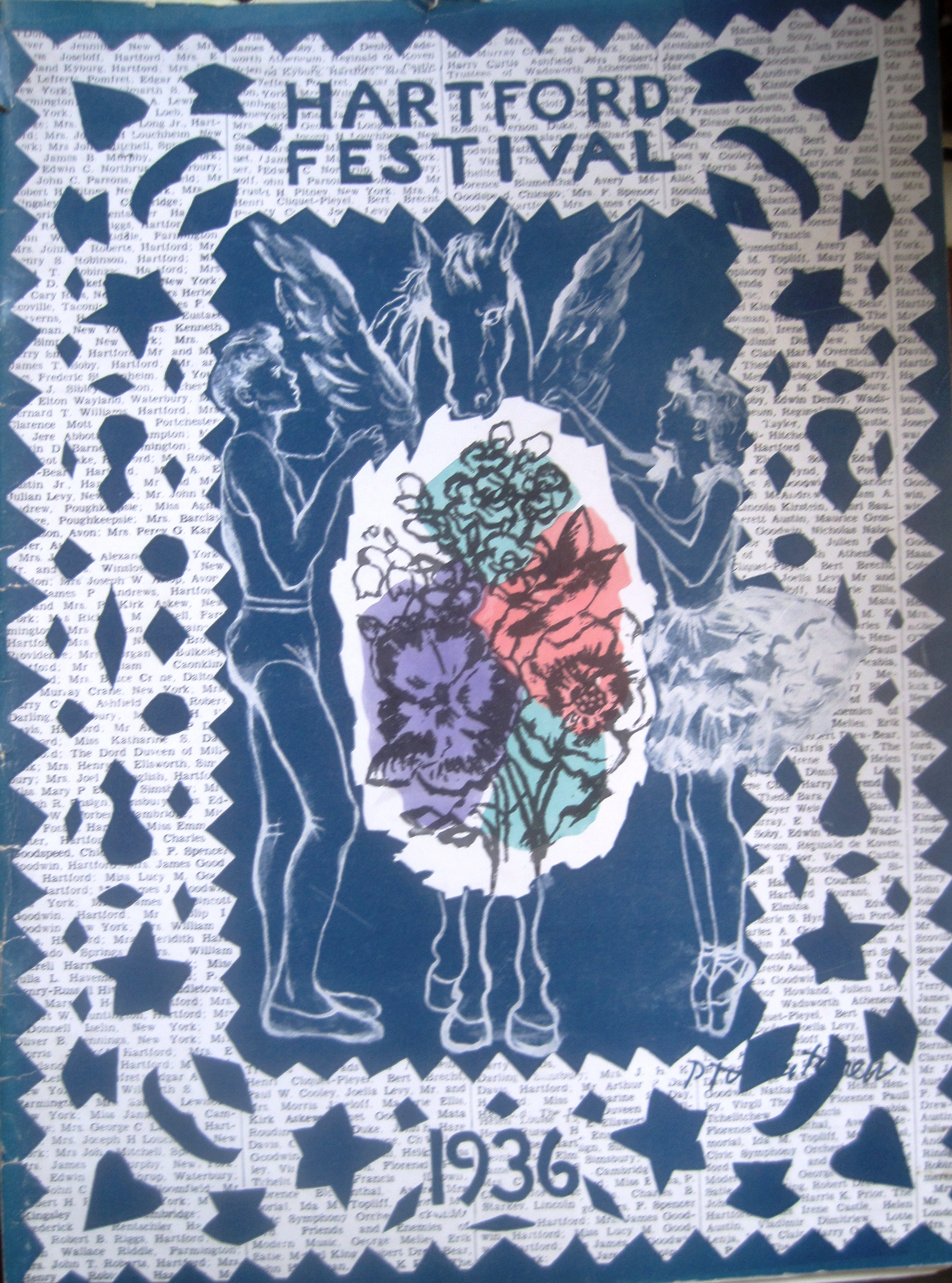
A17.1928: Souvenir Program, Théâtre Sarah-Bernhardt, XXIe Saison des Ballets Russes de Serge de Diahilew, 1928. (textured lithograph Tchelitchew cover)
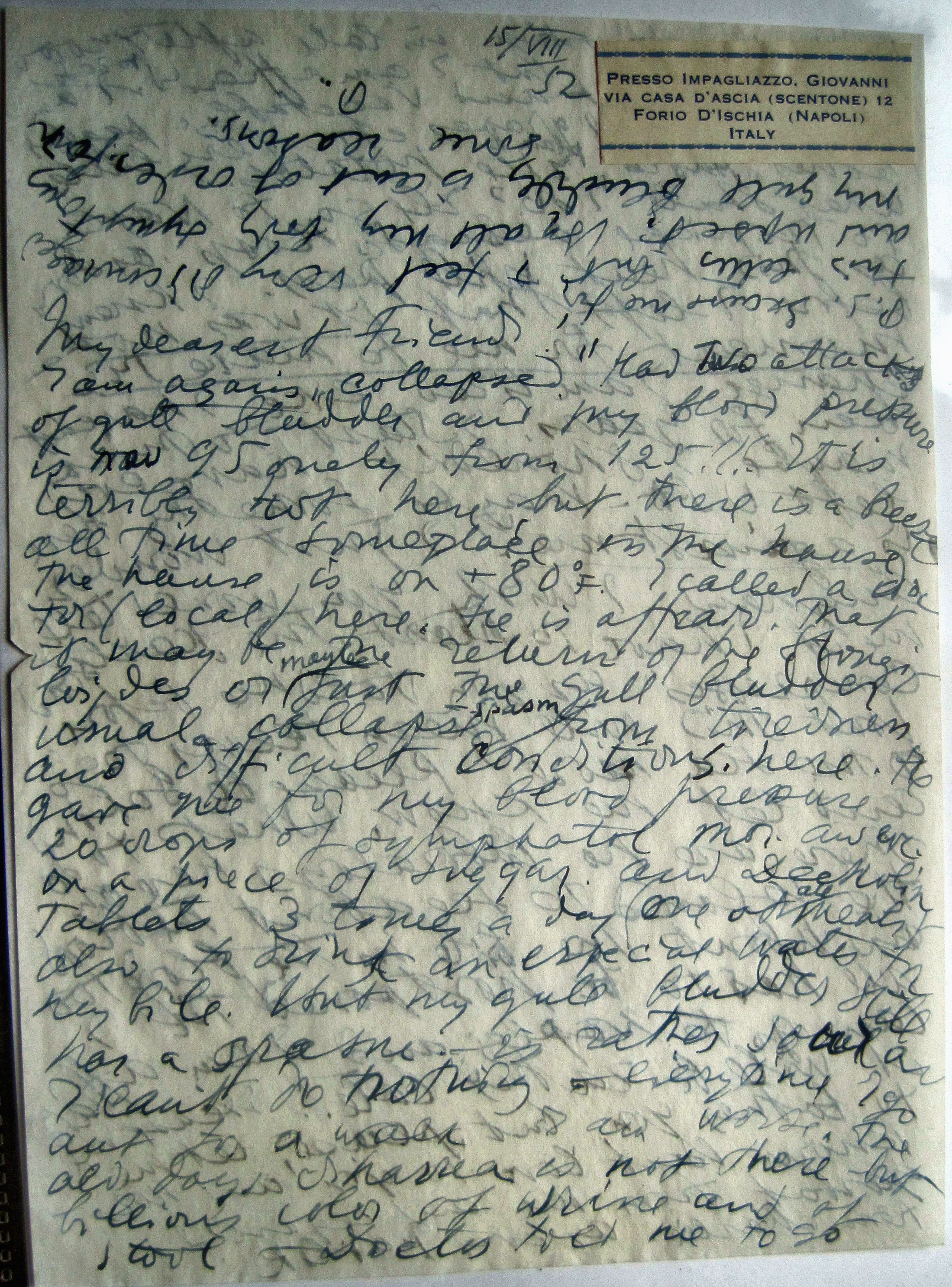


addressed from Italy in 1952 to
his personal doctor A. Sarbat in New
York with some very personal info in it. 2 pages and original envelope
inscribed on both sides. Signed “As ever Pavlik” and dated 15 VIII 52. Provenance:
R.M. Smyth &Co, NYC, auction #248, May 5, 2005 lot 303. The letter starts:
“My dearest Friend! I am again collapsed. Had two attacks of gull bladder and
my blood pressure is now 95 only from 125!!! It is terribly hot here but there
is a breeze all time some place in the house. The house is on +80°F. I called a
doctor (local) here…” - following with 2 pages of his health state details