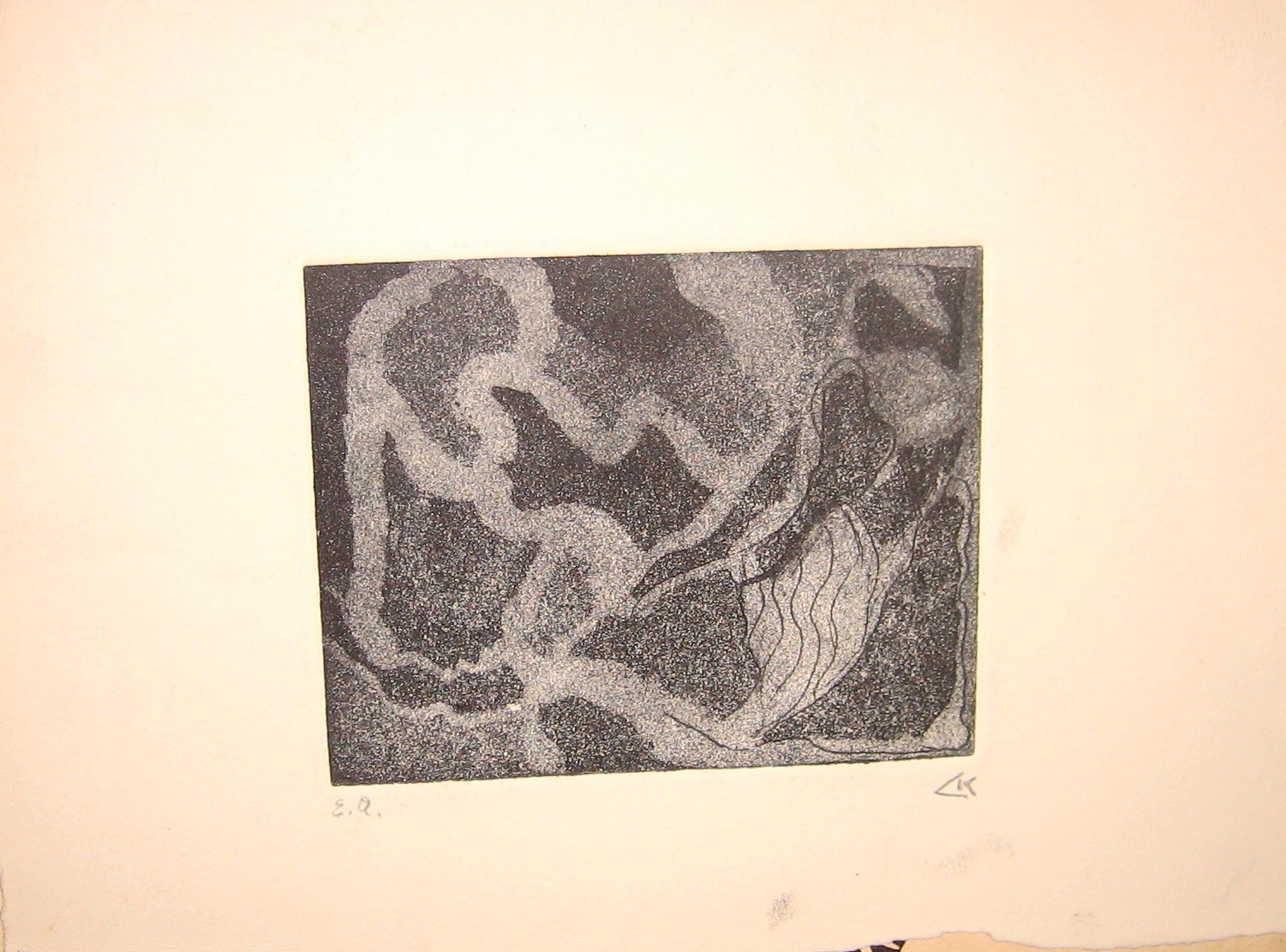
Drypoint, 1922, signed in pencil, from the edition of 200, on wove paper, with margins
8x10 inches
-
ITEM #KANDOA1
$300
Woodcut, 1912, signed in pencil, probably impressions printed aside from the edition of 345 published in Klänge by R. Piper & Co., Munich, (there were a further 1200 examples included in XXème Siècle, 1938)
11x12 inches inches
 |
 |
 |
 |
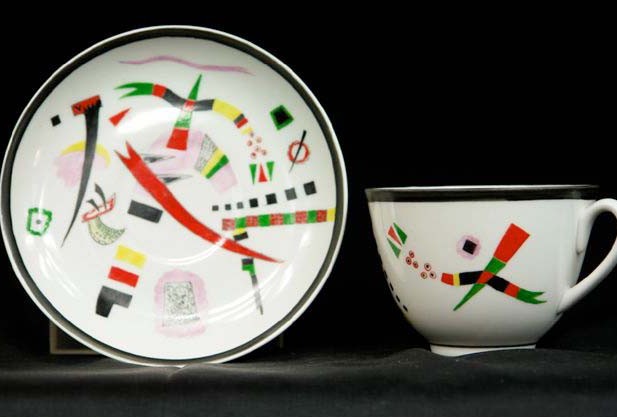
| ITEM #KANDOA3
$10000 |
Two cups with saucers. Cups and saucers by the Imperial Porcelain Factory, period of Nicolas II dated , both with underglaze green mark of Nicolas II monogram and date, both with later State Porcelain Factory mark of hammer, sickle and cog, marked with Kandinsky monogram, pattern numbers 141 (151 the second one), dated 1923 and inscribed “Drawing by V. Kandinsky”all in blue overglaze. Height of the cups 6.5 cm, diameter of the saucers 14.5 cm. (N. Lobanov-Rostovsky. Revolutionary Ceramics Soviet Porcelain1917-1927, London 1990, pp 129-130, where other works on porcelain after Kandinsky are illustrated). Similar cup has been sold at Christies, London, 13.06.07 lot 248 for 62400GBP |
 |
 |
 |
| ITEM #KANDOA4
$1000 | Composition XII, oil/canvas, signed and titled low right, 53x65 cm. |
Wassily (Vasili Vasilevich) Kandinsky was born on December 16, 1866, in Moscow, Russia, and spent his early childhood in Odessa. He played piano and cello from his early age. He had the physiological gift of synaesthesia cognate with that of composer Alexander Scriabin, and writer Vladimir Nabokov, which enabled him to hear colors and to see sounds. Kandinsky wrote: "Colors are the keyboard, the eyes are the harmonies, the soul is the piano with many strings. The artist is the hand that plays, touching one key or another, to cause vibrations in the soul." He earned his Law degree from the Moscow University and lectured there until 1896. At age 30 he changed his life and career completely and moved from Russia to Europe. From 1896-1914 Kandinsky lived in Munich. There he studied art anatomy, drawing and composition under Anthon Azbe for two years. From 1897-1900, he studied in Munich Academy of Art and graduated from the class of Franz von Schtucke. In 1901 he founded "Falanga" artistic movement and school, where he also taught his ideas in art. At that time his paintings represented his earlier impressions from seeing the Russian folk art coupled with his musical imagination. Synaesthetic ability led him to creation of his original style, focused more on series of colors than on formal details. His paintings from that period, like "The Blue Rider" (1903), are steps to creation of the modern abstract art. Kandinsky was the founder and active member of some of the most influential art movements. In 1911 he founded Der Blaue Reiter (The Blue Rider) together with Franz Marc, and included such artists as August Macke, Paul Klee, Alexej von Javlensky, and other painters fundamental to Expressionism. The group held two important exhibitions in 1911 and 1912 touring Germany, for which Kandinsky also included paintings by Henri Rousseau. Kandinsky was the main driving force behind the start of the new movement: he chose artists, collected their works, and published an almanac. In his writings Kandinsky promoted abstract art. He formulated his ideas of spirituality in art, his color theory, and the concept of autonomous color painted apart from an object or form. The start of WWI in 1914 forced Kandinsky back to Russia. There he taught art in Moscow and visited St. Petersburg. In 1916, he met Nina Andrievskaya who became his wife in 1917. During and after the Russian Revolution of 1917, he was involved in art teaching and museum reform. He published an autobiographical book 'Stupeni' (Steps 1918). From 1919-1921 he was the Chairman of Russian Art Acqusitions Commission, taught at VKHUTEMAS, and was elected the Vice-President of Russian Academy of Arts. In 1921 Kandinsky left Russia and joined the Bauhaus movement in Weimar, Germany. He was invited by Walther Gropius, the founder of Bauhaus, an innovative school of art and architecture. There Kandinsky taught design and advanced color theory, as well as an abstract painting class. In 1933 Bauhaus was banned by the Nazis in Germany, and Kandinsky moved to Paris. He became a French citizen in 1939 and continued living and working in Paris during the Nazi occupation in WWII. His studio in Neuilly-sur-Seine, near Paris, was frequently visited by 'Joan Miro' and younger artists. He became established internationally through several exhibitions, and his works were acquired in the USA by Solomon Guggenheim. Kandinsky expressed his creative achievements in the series of seven large "Compositions" (1911-39), which are widely acclaimed as the culmination of an abstract style in art. Wassily Kandinsky died on December 13, 1944, in his studio in Neuilly-sur-Seine, France. He is recognized as the developer of Abstractionism in modern art. Kandinsky belongs in the Pantheon of the 20th century artists alongside Pablo Picasso and Henri Matisse.