
L'Arc de Triumph. Signed lower left c.1927. 52 x 39". Oil on canvas. Provenance: Coll. Bernard Davi; exhibited: “A Time to Gather… RUSSIANART From Foreign Private collections”, State Russian Museum, Saint-Petersburg, February-June 2008, Moscow - Exhibition Center "Tsaritsyno", June-July 2008, Palace Editions,2008, illustrated in the catalog p. 203 ill 141
Authenticity confirmed by Любовь Шакирова, старший научный сотрудник отдела живописи второй половины XIX — начала XXI века Государственного Русского музея who wrote a detailed annotation in the catalog.
In original Italian XVI century hand carved and painted frame flanked with two Roman goddesses figures; illustrated in Русское Искусство magazine Moscow, 2015 v4 p 83.


Portrait of poet Anna Akhmatova. Signed and dated 1921 lower right, Indian ink on paper. 14 x 10". Published in “Portrays”, text by E. Zamiatin, M. Kuzmin, M. Babenchikov. Petropolis, Peterburg,1922. p.25 and in “Anno Domini”, Berlin, 1923. Bibliography: “A Time to Gather… RUSSIANART From Foreign Private collections”, State Russian Museum, Saint-Petersburg, Palace Editions,2008, illustrated on p.25. Exhibited: “Faces of Russia”, February 2007, West Palm Beach International Art Fair, USA (illustrated on page 28 of the catalog). In original European hand-carved ebonized frame art nouveau with brass decorations.


Portrait of poet Boris Pasternak. Signed with initials and dated 1921 lower right, Indian ink on paper. 17 x 11". Published in “Portrays”, text by E. Zamiatin, M. Kuzmin, M. Babenchikov. Petropolis, Peterburg,1922. p.66 and in “Vozrozhdenie” N102, 1960. Bibliography: “A Time to Gather… RUSSIANART From Foreign Private collections”, State Russian Museum, Saint-Petersburg, Palace Editions,2008, illustrated on p.25.. Exhibited: “Faces of Russia”, February 2007, West Palm Beach International Art Fair, USA (illustrated on page 28 of the catalog). In original European hand-carved ebonized frame art nouveau with brass decorations


Portrait of artist Alexander Iacovleff, 1919. Two China ink drawings on paper in the same framework, one on blue paper, dated lower left, and one on brown paper, initialed lower left. Provenance: Collection S. Ernst and D. Bouchene, acquired from the last in 1985; sale Etude Castor-Hara Paris 4 Dec 2009 lot 140; 33 x 29 cm (blue paper) and 34 x 20 cm (brown paper) Compare with another signed variant of the same portrait Sotheby’s sale NY 15 Apr 2008 lot 81 (confirmed b y Andre and Vladimir Hofmann; will be included in the forthcoming Annenkov catalogue raisonné.). In original Spanish first quoter of XVIII century rococo style hand carved and guilt frame (provenance for the frame Alcala Subastas Madrid sale 01.03.2013 lot 208).


Villas by the river. Oil/canvas, signed low right, 14x11 inches. C.1925-8. For the larger version of the similar painting see Sotheby’s London May 26 2004, lot154.

Portrait O.K.["A Model"]. Indian ink on paper. 10 x 8". Another variant published in "Portraits", text by E .Zamiatin, M. Kuzmin, M. Babenchikov, Petropolis, Peterburg, 1922, p99.PROVENANCE: Lot # 202 Sotheby's, New York NY 08 Oct 1986

Costume design for an officer with a gun, w/c on paper, signed low right, 19x 12 inches.

“A Buccaneer on the sea shore". Stage set. Signed with initials and dated 1921 lower left, gouache on paper, 11x18". In original English beginning of the 20th century art nouveau (pre- Raphaelite) style oak hand-carved and parcel gilded frame

Hommage a Modigliani [Nude] Oil/canvas, signed low left c 1930 61x91 cm

Ballet Russe Irina Grjebina, poster, Imp. Affiches et Publicite, Paris. Color lithograph c.1950. 48 x 34". Backed on linen. Provenance: Christie’s 21 May 1996 lot 240. 2,000.- Another version of the same poster (textual differences) 25x17” Backed on linen. 1,000.- Yet another version 47x64 inches iinscribed Jeudi 19 Mars au Royal 2,000.-

(Design). Tin casket for the powder "Silhouette"TEJE company, Moscow, circa 1920. Black and white varnish on tin raised stamping. 2.5 x 2.5 x 1".

ANNENKOFF – CHERONNET (Louis). Extra-muros.
Préface de Jules Romains. Lithographies originales par Georges Annenkoff. Paris, Au Sans Pareil, 1929 ;
in-4, broché. Édition originale. Premier tirage des 26 lithographies originales hors-texte, des 2 vignettes et couverture de Georges Annenkoff. Tirage limité à 270 exemplaires numérotés ; l’un des 220 sur papier vélin blanc.
Envoi autographe signé de l’auteur « À Georges Roux, européen de province son ami. »
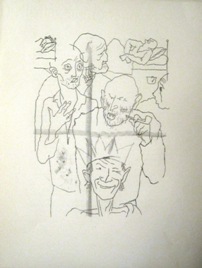


Still lifes. Etching (copy a), gouache and 31 original lithographs in the book enclosed: Courthion P. Paris: Chronique du Jour, 1930. a/Copy N12 of 351 with original Etching 1\65,signed by G.Annenkov. Presentation copy, inscribed by G.Annenkov to V.G.De-Bazil', 1933. SOLD b/ usual copy N 336 just with a gouache $1000


Nude (portrait of Valentina Motyleva) Mixed media on paper 47x36 cm signed with Cyrillic initials low right

BOOKPLATE

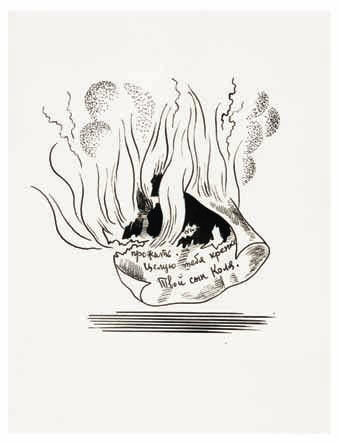
Group of preliminary illustrations for unpublished book. Ink on paper (255 x 200 mm).
An unpublished title page for Lidiya Chukovskaya, Povest o skorbnoi materi [The Story about a Mother’s Sorrow] (Paris: “Pyat Kontinentov,” 1965).
[With:] Illustration of burning manuscript. Ink on paper (190 x 155 mm). Framed.
Chukovskaya’s deeply personal writings reflect the human cost of Soviet totalitarianism, and she devoted much of her career to defending
dissidents such as Aleksandr Solzhenitsyn and Andrei Sakharov. She was the daughter of the celebrated children’s writer Kornei
Chukovsky, wife of the scientist Matvei Bronstein, and close associate
and chronicler of the poet Anna Akhmatova.


Four drawings, signed with initials (one from Russian period), 30x23 cm each Provenance: Ancienne collection du général Victor Tanguy Sale Rouillac Paris 26.02.2017 lot 56

Costume design "Gondole". Gouache et rehauts d'or monogrammée titrée et numérotée 7. 50 x 32 cm Provenance: Ancienne collection du général Victor Tanguy Sale Rouillac Paris 26.02.2017 lot 56

NUDE preliminary drawing for the book De Choisy. Histoire de Madame de Sancy.Paris,1946 (see item below) Ink on paper 26x10 cm Signed with initials GA low right Provenance: Ancienne collection du général Victor Tanguy Sale Rouillac Paris 26.02.2017 lot 56


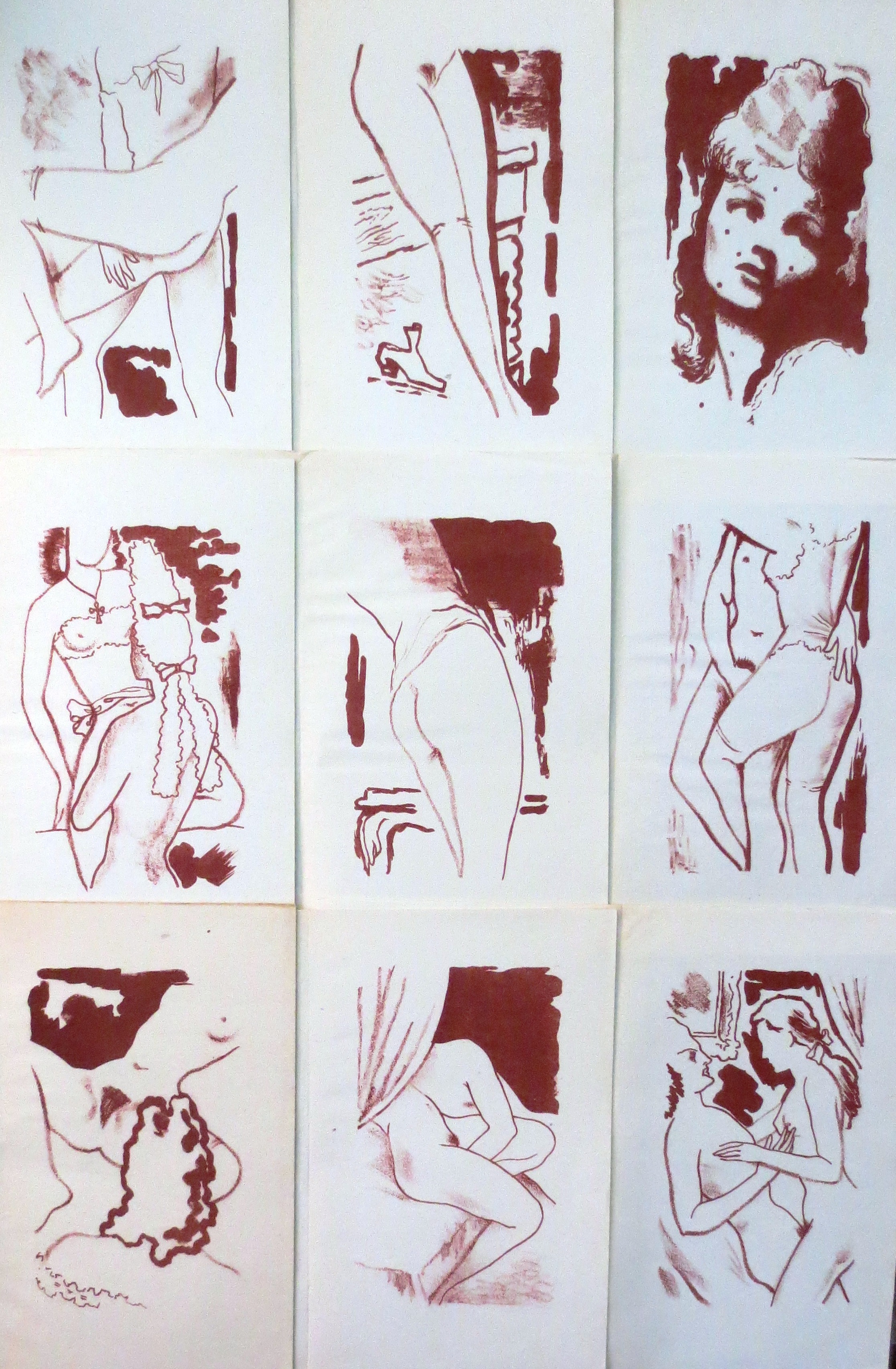
GEORGE ANNENKOFF
Two erotic books with 18 lithographs each
a) De Choisy. Histoire de Madame de Barres. Paris, Editions de Quatre Vents,1945.1/650.Copy H.C.[not for sale],1/30,with additional set of 9 erotic (lesbian) lithographs. In original box.
b) De Choisy. Histoire de Madame de Sancy.Paris,1946, Copy H.C.[not for sale],1/30,with additional set of 9 erotic (lesbian) lithographs. In original box.
(available for purchase separately)

Dostoevsky, Scandaleuse Histoire, translated by Alexis Remisoff and Jean Chuzeville, illustrated by Y.Annenkov, Paris, 1935 (in original slipcase) with 15 original full page lithographs and multiple vinettes numbered copy #398/750
To see details click an image or HERE


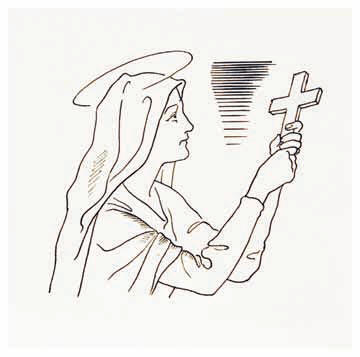

Two religious book illustrations (very unusual for Annenkov in sense but very Annenkov in style) – Crucifix and Saint Mary [circa 1960]. Indian ink on paper, 6x10 and 6x6 inches. Provenance: Estate of Yuri Annenkov, Sotheby’s, London, 22.05.2002, lot 128; Bloomsbury New York, Sale 21.05.08 lot 155. Bibliography: Art+Auction, March 2008, illustrated on p. 84.Crucifix is in European 18th century hand carved with religious themes and painted on mother of pearl surface frame; Saint Mary is in 18th Century carved and gilded Canon frame, heart-shaped corpus with scrolling acanthus leaves, topped with a bishop’s hat (provenance for the frame: Dorotheum Rahmen. Wien 10.04.2003, lot 413)
