

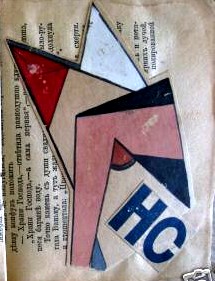
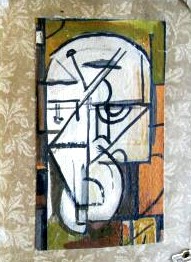
Puni. Petrograd. Suprematist artist’s book with collages, cutouts and paintings, circa 1920. (140 x 105 mm). Original patterned paper wrappers with a collage on the front and a gouache affixed to the inside of the back wrapper. Provenance: Puni archive with artist’s personal stamp on the back wrapper.
Provenance:
Bloomsbury New York, Sale 29.10.08 lot 234
Puni was one of the most radical of Russian avant-garde artists of the early twentieth century. After studying abroad in Paris, he joined Kazimir Malevich’s Suprematist group of artists that included Aleksandra Exter, Ivan Kliun, Liubov Popova, Olga Rozanova, and his future wife Ksenia Boguslavskaya. He also organised two key exhibitions of the Russian avant-garde in Petrograd, “Tramway W” in 1915 and the last Futurist exhibition “0.10” in 1916. In 1919 he taught at the Vitebsk Art School with Marc Chagall. In 1920 he émigrated with his wife, stopping first in Germany and then settling in France where he changed his name to Jean Pougny. This unpublished book is a work of art unto itself. In addition to the lettered collage on the front cover, there are nonsense words cut out of pages, plucked from an unidentified Russian pamphlet, with the pages behind painted to give the letters various colors. A gouache collage is attached to a later leaf and a stunning small Suprematist goauche is afixed to the recto of the back wrapper. Provenance: Puni archive with artist’s personal stamp on verso;


Three Postcards. Gouache of Suprematist persons painted on a postcard, circa 1920. (140 x 90 mm). Provenance: Puni archive with artist’s personal stamp on verso
Provenance:
Bloomsbury New York, Sale 29.10.08 lot 235


Three Postcards. Gouache of Suprematist persons painted on a postcard, circa 1920. (140 x 90 mm). Provenance: Puni archive with artist’s personal stamp on verso
Provenance:
Bloomsbury New York, Sale 29.10.08 lot 236


Three Postcards. Gouache of Suprematist persons painted on a postcard, circa 1920. (140 x 90 mm). Provenance: Puni archive with artist’s personal stamp on verso.
Provenance:
Bloomsbury New York, Sale 29.10.08 lot 237

Costume of a XVIII century gentleman. Pencil, gouache and silver paint on paper, signed low right, 20x13 inches.

Costume of a musketeer. Pencil, gouache and silver paint on paper, signed low right, 20x13 inches.

Costume of a gentleman with a stick. Pencil, gouache and silver paint on paper, signed low right, 20x13 inches.

Costume of a romantic gentleman. Pencil, gouache and silver paint on paper, signed low right, 20x13 inches.

Costume of a romantic lady. Pencil, gouache and silver paint on paper,signed low right, 20x13 inches.
Produced c.1923 for Maison Granier. Provenance: Collection Serge Lifar (stamped by his personal seal up right – the seal is reproduced, for example, in Sotheby’s Ballet Material and Manuscripts from the Serge Lifar Collection, London 5.9.84 lot66). Other similar costumes are reproduced in POUGNY Catalogue de l’oeuvre, v1 Russie-Berlin 1910-1923 by H. Berninger, Tubingen, 1972 ##278-281 p. 233; and in Sotheby’s Diaghilev Ballet Material, NY, 18.7.1968, lots 53, 54. Maison Granier (theatrical costumer company in Paris) have been established in 1848 and existed till 1940 producing costumes for many theatres in Paris. Many Russian émigrés artists (Annenkov, Benois, KOROVIN, Pougny et al) used to work for that company.

Portrait of George Balanchine, oil on canvas, signed low right and dated 192(7?). Inscribed "George Balanchine" on the back

Etagere Oil on paper with collage laid on cardboard [1944] Signed with name stamp up left - 50 x 41 cm - Certified by Mm. Jean Pougny, 8-12-1966 (Xana Bougouslavskaya) on the reverse. Exhibited: 1959 Pougny (Oeuvres de jeunesse et Ouevres Choisies), Galerie Coard, Paris, Cat. No 30 Published: H. Berninger, Jean Pougny 1892-1956, catalogue de l'oeuvre, vol. II, Zurich, 1992, no.802, Numero d’Archives 998-32B (illustrated on p.208) Provenance: De Vuyst, sale 23.10.2010 lot 243 $6000; Sotheby's June 6, 2011 London, United KingdomIn lot 16 30000 GBP; in an original Dutch ebonized and tortoiseshell frame.


INTERIOR Oil/wooden board signed low left in Cyrillic IV. PUNI 12.25x9.75 inches Exhibited: Petrograd, Last Futurist Exhibition of Paintings, "0,10" 19.12.1915-19,01.1916, # 102 of the catalog ( typographic label of the exhibition on verso and hand written inscription with number of the painting in catalog, its title, price in roubles and address of the artist in Petrograd in that period of time "N102 Interieur 100 r. Petrograd, Gatchinskaia 30, ap 22"

Costume design for Chevalier Servant (pour le costumier Granier, Paris) Watercolor, gouache and wash on paper Dimensions : Sheet Cm : 52,5 x 36,5 cm Inch : 20 5/8 x 14 3/8 in; image 41x30 cm. Signature: cachet d'atelier en bas a droit, au-dessus annotation Paris 1923. Published: H. Berninger, Jean Pougny 1892-1956, catalogue de l'oeuvre 1910-1923, vol. I, Zurich, 1972, no.281 (illustrated p.233) Provenance: Numero d'archives 455 B; M. Nikta D. Lobanov-Rostovsky, New York - vente Sotheby's Londres 18 Juillet 1986 cat # 54; Swann Galleries sale 2337, 20th Century Illustration, New York, Thursday, January 23, 2014 lot 187

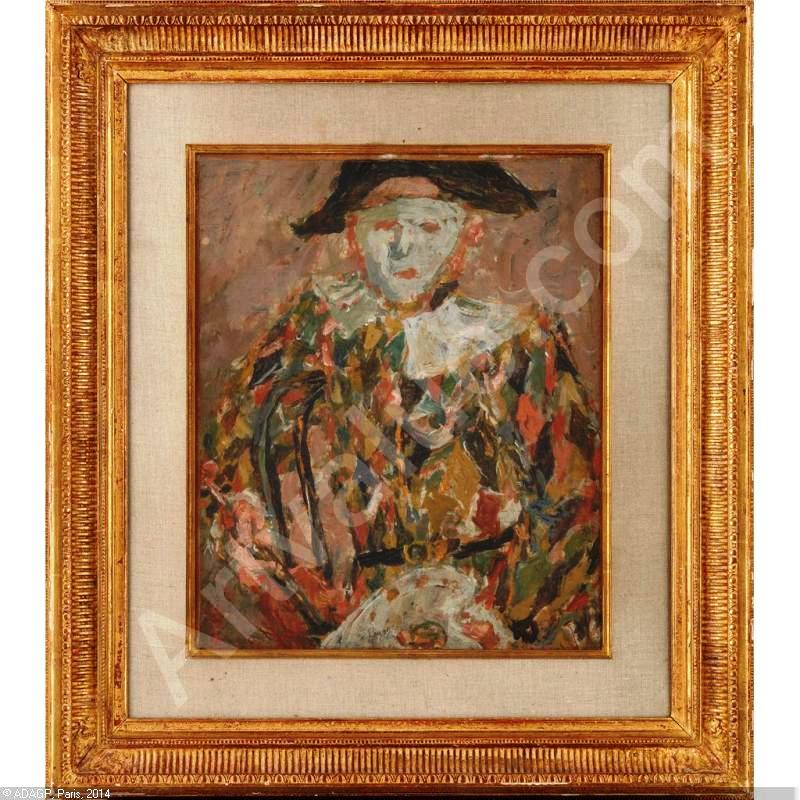
Arlequin - 1934
Huile sur toile
Signée en bas au centre "Pougny"
h: 46 w: 38 cm
Provenance : Ancienne collection Robert Simon, Paris Collection particulière, Londres; Sale «490», British and European Paintings Lyon&Turnbull Edinburgh 24/05/2017 lot 76; Sale Artcurial Paris 31.10.2017 lot 77 10000 euro
Expositions : Paris, Salon des Tuileries, 1934, n°2024; Saint-Etienne, Musée d'Art et d'Industrie, "Exposition Pougny, Novembre 1958, n°11 (the catalog is attached); Paris, Galerie Coard, "Pougny - Oeuvres de jeunesse et oeuvres choisies"1959 (the catalog is attached).
Bibliographie : A. Lannoux in "Les Lettres françaises", Paris, 1959, reproduit; H. Berninger, "Pougny Catalogue de l'oeuvre 2-Paris-Côte d'Azur Peintures", Editions Ernst Wasmuth, Tü bingen, 1992, n°487, reproduit en noir et blanc p. 139; Commentaire : Cette oeuvre est répertoriée dans les archives de l'artiste sous le n° 530-585A.
‘One characteristic of Puni which is of particular importance is the type of canvas he used to execute his paintings. Puni never used new canvases, preferring old ones, of which he always kept a reserve under the carpets in his studio. From 1937 onwards, he chose aged canvases, often cracked and worn, even revealing their weave, which he patiently prepared secretly before beginning to paint. It was then that he also got into the habit of mounting his paintings on wood and especially on masonite, by a secret procedure that gave stability and permanent protection to his works, which he always had framed under glass. The warm and precious material paired with the superimposition of the layers and Puni’s play with the imperfections and accidents of his canvases gives his paintings their inimitable dreamy atmosphere, successfully reflecting his inner emotions.’ (H.Berninger and J.-A. Cartier, Pougny, Catalogue de l’oeuvre, vol.1, Tübingen: Ernst Wasmuth, 1972, pp. 86-87)

Two book illustrations on one piece of paper, front and back.FRONT: Draft for book cover of Winter Night. c. 1921. Ink on paper (328 x 220 mm). Signed in Cyrillic “I. Puni” upper left. Back: Abstract figure. Ink on paper (220 x 160 mm). Provenance: artist’s personal archive (stamp on the back);Ksenia Boguslavskaia;


Rue brumeuse signed 'Pougny' (lower right), signed again and dated '1933/Pougny' (on the reverse), oil on canvas 16¾ x 7in. (42.5 x 17.7cm.) Published: H. Berninger, Jean Pougny 1892-1956, catalogue de l'oeuvre, vol. II, Zurich, 1992, no.367 (illustrated p.107) Exhibited: 1933 Peintures de Pougny, Galerie Jean Castel, Paris, Cat. No 14; 1961 Galerie Charpantier Paris Cat No 44.
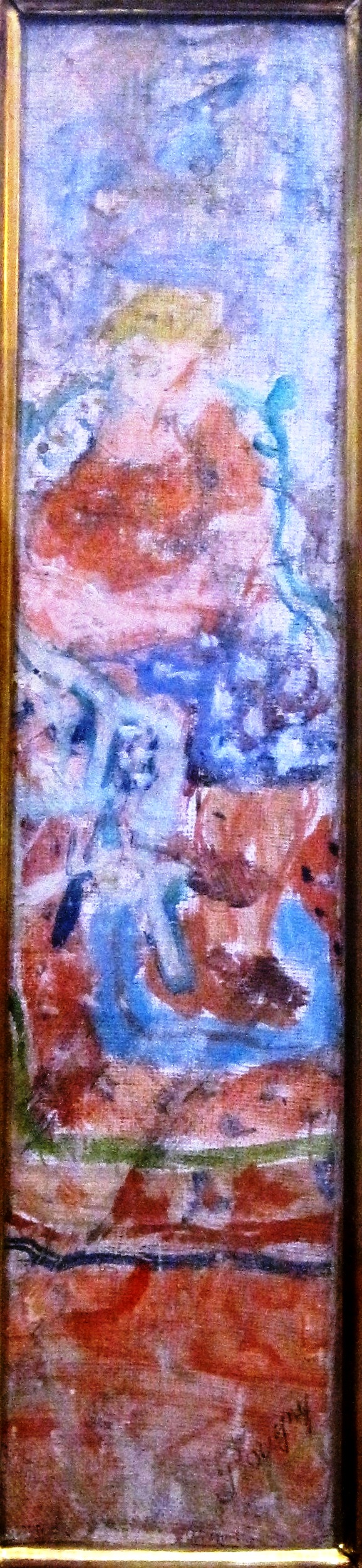
Woman in her garden oil/canvas 33 x 7 cm
Signed lower right Pougny Provenance: sale Millon&Associes, Druot, June 22 2011 lot 87

Antibes (Suburban street) oil/ cardboard 21.5 x 38 cm Stamp of the signature at the bottom right Pougny Date 1941-1942 Bears a label on the back Mr. Claude Robert (auctioneer in Paris) 2072 Pougny Published: H. Berninger, Jean Pougny 1892-1956, catalogue de l'oeuvre, vol. II, Zurich, 1992, no.556, Numero d’Archives 660-32B (illustrated on p.154) Provenance: sale Millon&Associes, Druot, June 22 2011 lot 180


Three book illustrations. c. 1921. Nightclub dancing. India ink on paper (325 x 245 mm). [With:] Two men and lamp post. Ink on paper (205 x 205 mm). [And:] Old woman and window. Ink on paper (170 x 130 mm). All signed by the artist. Provenance: artist’s personal archive (stamp on the back);Ksenia Boguslavskaia; Puni was married to poet and artist Ksenya Boguslavskaya who was a member of both Jack of Diamonds and Mir Isskutva [World of Art] artist collectives.

Futurists. Roaring Parnassus. Petrograd. 1914. 124 pp.Lithograph cover by Ivan Puni.. Includes 13 lithographs by D. and V. Burliuk, 2 lithographs by O. Rozanova, 2 lithographs by Pavel Filonov, 3 by Ivan Puni. Pages are uncut. Футуристы. Рыкающий Парнас. Петроград. 1914.г. 124 стр. с илл. В литографской обложке Ивана Пуни.17 22 см. Включает 13 литографий Д. и В. Бурлюков, 2 литографии О. Розановой, 2 литографии Филонова, 3 литографии Ивана Пуни. Неразрезанный экземпляр .
CLICK HERE TO SEE details