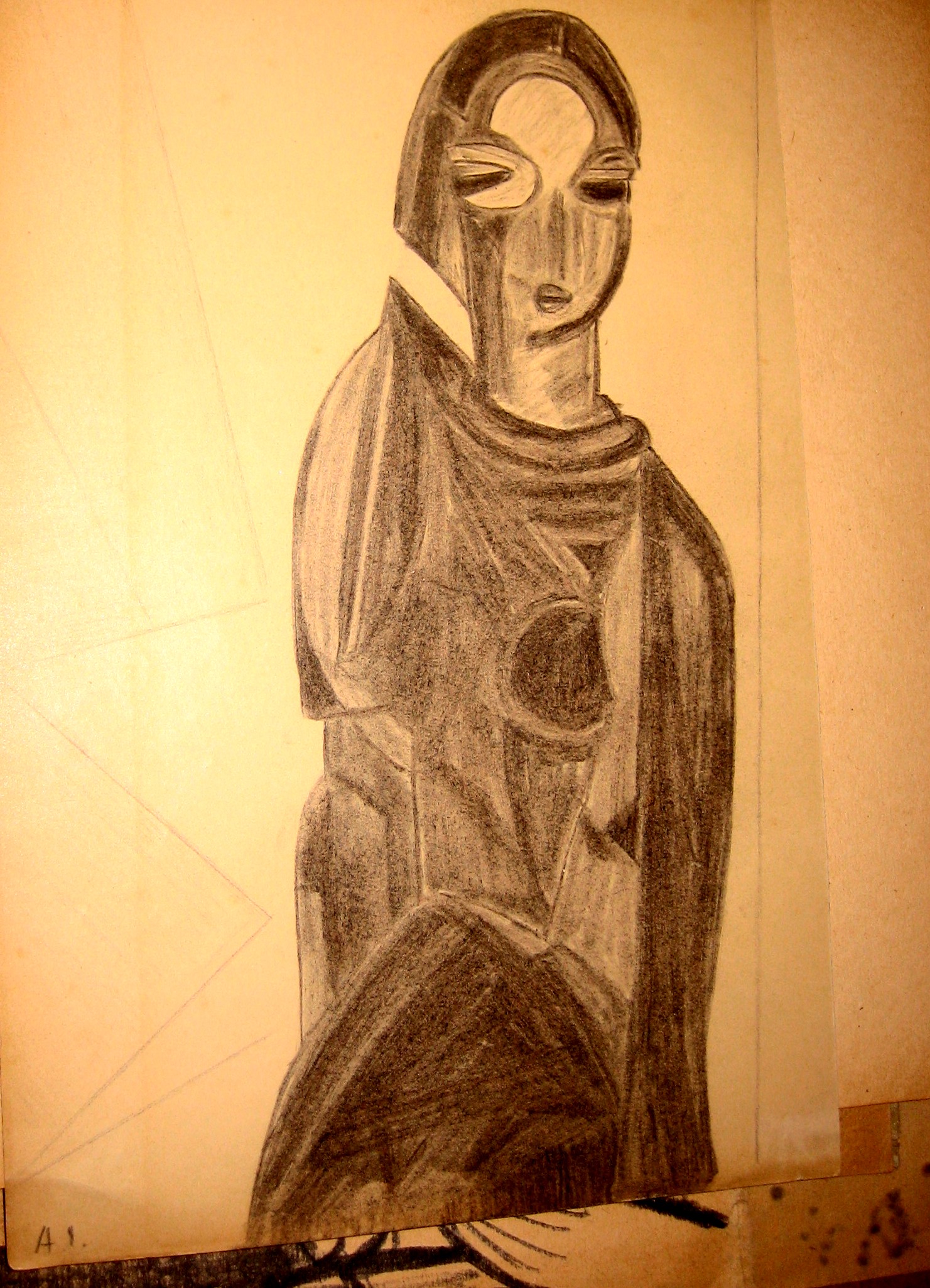
PORTRAIT OF A WOMAN
Crayon on paper
signed with initials low left
C.1917 9x13".
-
ITEM #AIA1
$500
BIOGRAPHY OF THE ARTIST
Birth Year : 1864 Death Year : 1941 Country : Russian Federation Alexei von Jawlensky was born in Kuslovso, Russia. In keeping with family tradition, he entered the Moscow military academy at the age of eighteen. During this time, however, he also dabbled at painting and attended the St. Petersburg Academy of Art. While on vacations, he often visited the estate of a young painter, Marianne von Werefkin, with whom he emigrated to Munich in 1986. In Munich he enrolled in the Art Academy, of which Kandinsky was the director. Jawlensky's studio as well as the salon that von Werefkin would come to hold, soon became gathering places for young artists with new ideas. Jawlensky's meeting with Kandinsky was to have a profound effect on the young painter's artistic sensibilities. He was also very taken with the work of van Gogh, Cezanne and, most importantly, Matisse, whom he discovered during his travels in France. Jawlensky incorporated Matisse 's powerful use of pure color in his landscapes, still lives and portraits. In 1912 he joined the Blaue Reiter, but when World War I broke out, he was forced to leave Germany, and for several years he lived in Switzerland, painting modest landscape scenes from his studio. It was while he was in Switzerland that Jawlensky developed the form of art that was to bring him ultimate fulfillment. With fervent color he painted landscapes and large heads. The repetition of these themes took on an increasingly symbolic and meditative quality. In the final version of his style-dating from around 1917 until his death-he painted only heads: the human face as a simple geometrical design, an object of religious mediation reduced to a figure as simple as the cross. Jawlensky made of his art a modern religious icon, drawn from the piety of his Russian Orthodoxy.
Алексей Георгиевич Явле́нский (Алексей фон Явленский) родился в городе Торжок, Россия в 1864. В 1889 отказался от карьеры российской императорской гвардии и началь обучаться живописи у Ильи Репина при Петербургской академии художеств. В 1896, разочарованный реализмом, он переехал в Мюнхен, где познакомился с Василием Кандинским оказавшим на него решающее в его жизни влияние. В 1905, будучи во Франции, Явленский работал вместе с Анри Матисом. В 1909 он основал вместе с Василием Кандинским, Адольфом Эрбслох, Габриэлой Мюнтер, Марианной Верёвкиной и другими «Новое мюнхенское художественное объединение». Он тоже сотрудничал с обьединением «Синий Всадник». В 1914, после начала войны, Явленскому пришлось покинуть Германию и переселиться в Швейцарию. Здесь он начал свои «Вариации» - цикл работ, посвящённый ландшафтной тематике. В 1921 он переехал в Висбаден, где прожил до своей смерти. В Висбадене Явленский познакомился с коллекционером и меценатом Генрихом Кирхгофом, который стал его материально поддерживать. В 1924 Явленский вместе с Василием Кандинским, Паулем Клее и Лионелом Фейнингером основал объединение «Синяя четвёрка», проводившее свои выставки в Германии и США. В 1938, страдая от артрита, Явленский прекратил заниматься живописью. В 1937 72 работы художника были конфискованы нацистами как «Дегенеративное искусство». Явленский умер в Висбадене в 1941.