Lot Description
Valentin Serov (1865-1911)
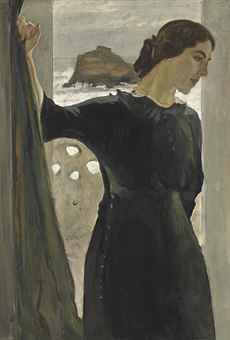
Portrait of Maria Zetlin (1882-1976)
signed with Cyrillic initials and dated 'V S/910' (centre left)
tempera and oil on board
41 7/8 x 28 7/8 in. (107 x 73.4 cm.)
Painted in October-November 1910
Валентин Серов - личность в истории русского искусства, которую нельзя сравнить ни с кем, писал на заказ портреты и вольные композиции, отмеченные особой жизнерадостностью. Его персонажи - живые, запечатленные за доли секунды: мгновенно зарумянилась под пристальным взглядом художника Вера Мамонтова («Девочка с персиками»); «Княгиня Ольга Орлова» вот-вот еще приподнимет уже и так надменно вздернутые брови; в настоящей работе – еще мгновение, и Мария Цетлин сейчас сделает шаг от окна. «Портрет Марии Цетлин (1882-1976)», - самая изысканная из всех представлявшихся на аукционе Christie’s работ Серова, и торги ее в пользу музея города Рамат Ган - это событие колоссального значения.
Портрет был написан в 1910 году и то, как Серову случилось написать портрет Марии Цетлин (урожденной Тумаркиной) осталось для потомков в записях благодаря просьбе Ильи Зильберштейна к натурщице припомнить и записать все обстоятельства. В 1906 году Осип Сергеевич Цетлин, будущий свекор Марии, встретился случайно с прославленным русским художником-портретистом в парижском ресторане «Prunier». Узнав, что Серов просил пять тысяч рублей за портрет независимо от количества натурщиков - Серов, который писал Николая II и прочих представителей высших кругов русского общества - Осип Сергеевич предложил ему тройную цену за то, чтобы тот написал семейные портреты его самого, его жены и сына Михаила. Серов согласился, и они расстались. Три-четыре года спустя Серов и Цетлин, с которым на тот момент была юная красавица Тумаркина, снова встретились в том же ресторане. На сей раз к их столику подошел Серов, который попросил разрешения писать портрет Марии, пообещав, что, если она согласится позировать, он напишет семейный портрет бесплатно. Четыре месяца спустя Мария вышла замуж за Михаила Осиповича, и вскоре написала Серову, что согласна позировать.
Серов прибыл в Биарриц в середине октября 1910 года. Приехав на виллу Цетлин «Les Mouettes», художник тут же попросил хозяйку примерить все ее наряды, чтобы выбрать наиболее подходящий для портрета, и в конце концов остановился на простом черном платье, украшенном только ниткой жемчуга, в котором Мария встречала его на станции. На написание портрета ушло чуть больше месяца. Пока Мария позировала, ее муж читал им стихи и прозу вслух, что очень радовало Серова. Втроем они совершали длительные прогулки на автомобиле по овеянной ветрами Стране Басков, где великолепные виды суровых скалистых берегов и бурлящих морских волн будили воображение художника.
Мария Цетлин, умница и красавица, стала одной из первых женщин в Европе, получивших докторскую степень (она была доктором философских наук). Куда бы она ни переезжали вместе со своим вторым мужем Михаилом Осиповичем, они везде устраивала вечера, где встречались поэты, художники и писатели, где обсуждались проблемы того времени. Их дом в Париже, наряду с художниками Пикассо, Браком, Гончаровой и Ларионовым, привечал поэтов Райнера Марию Рильке и Илью Эренбурга. Эренбург вспоминал, как по возвращении в Москву в 1917 году в революционном порыве они тоже хотели проводить такие собрания: «В зиму 1917/18 года в Москве Цетлин собирали у себя поэтов, кормили, поили; время было трудное, и приходили все - от Вячеслава Иванова до Маяковского». (И. Эренбург. Собрание сочинений в 9-ти томах. Москва, 1966, том IVII, стp. 119). Когда революция не оправдала ожиданий, Цетлин отправились сначала в Турцию, потом вернулись во Францию, и позже, уже убегая от нацистского вторжения, эмигрировали в Америку.
К концу 1920-х годов Цетлин собрали значительную коллекцию произведений русского искусства, включавшую работы самых видных русских художников, таких как Наталья Гончарова, Петр Кончаловский, Леон Бакст, Александр Бенуа, Борис Григорьев, Михаил Ларионов и Валентин Серов. В середине Второй мировой войны, в 1941 году, Цетлин бежали в Нью-Йорк. Свою коллекцию они вновь увидели только после войны. До 1959 года большая часть собрания оставалась в семье, а в 1959 она была подарена муниципалите
Special Notice
These lots have been imported from outside the EU for sale using a Temporary Import regime. Import VAT is payable (at 5%) on the Hammer price. VAT is also payable (at 20%) on the buyer’s Premium on a VAT inclusive basis. This VAT is not shown separately on the invoice. When a buyer of such a lot has registered an EU address but wishes to export the lot or complete the import into another EU country, he must advise Christie's immediately after the auction.
Provenance
The collection of Maria & Mikhail Zetlin.
Donated by Maria Zetlin to the Municipality of Ramat Gan in 1959.
Pre-Lot Text
PROPERTY FROM THE MUNICIPALITY OF RAMAT GAN SOLD TO BENEFIT THE RAMAT GAN MUSEUMS
Literature
Exhibition catalogue, Esposizione internazionale di Roma, Bergamo, 1911, listed p. 294, no. 394.
Apollon, St Petersburg, 1912, illustrated p. [80], listed p. 32.
Exhibition catalogue, Baltiska utställningen [The Baltic Exhibition], Malmö, 1914, listed p. 231, no. 3222.
I. Grabar', Valentin Aleksandrovich Serov - Zhizn' i tvorchestvo [Serov - Life and Works], Moscow, 1914, pp. 201, 298, illustrated p. 225, listed p. 294.
Exhibition catalogue, Posmertnaia vystavka proizvedenii V. A. Serova [Posthumous exhibition of the work of V. A. Serov], St Petersburg, 1914, listed p. 21, no. 280.
Exhibition catalogue, Posmertnaia vystavka proizvedenii V. A. Serova [Posthumous exhibition of the work of V. A. Serov], Moscow, 1914, listed p. 26, no. 313.
V. Dmitriev, Valentin Serov, Petrograd, 1917, illustrated.
S. Ernst, V. A. Serov, Petersburg, 1921, p. 73.
Exhibition catalogue, Exposition d'Art Russe Ancien et Moderne, Brussels, 1928, listed p. 79, no. 841, illustrated.
Commemorative catalogue, Art Russe, Brussels, 1930, illustrated pl. XXVI and listed.
Exhibition catalogue, Exhibition of Russian Art, London, 1935, listed p. 84, no. 385.
Exhibition catalogue, Retrospektivní vystavy Ruského malírství XVIII.-XX. stol. [Retrospective exhibition of 18th-20th century Russian painting], Prague, 1935, listed p. 35, no. 151.
N. Simonovich-Efimova, Vospominaniia o Valentine Aleksandroviche Serove [Memories of Valentin Serov], Leningrad, 1964, pp. 119-121, 172.
I. Grabar', Valentin Aleksandrovich Serov - Zhizn' i tvorchestvo 1865-1911 [Serov - Life and Works], Moscow, 1965, p. 224, listed p. 341.
I. Zil'bershtein & V. Samkov, Valentin Serov v vospominaniiakh, dnevnikakh i perepiske sovremennikov [Valentin Serov in the memories, diaries and correspondence of his contemporaries], vol. I and II, Leningrad, 1971, vol. I pp. 9, 12, 15, 82, 83, 303, 456; vol. II pp. 110, 175, 256, 257, 353-358.
V. Leniashin, Portretnaia zhivopis' V. A. Serova 1900-x godov [V. A. Serov's portraits of the 1900s], Leningrad, 1980, pp. [253, 256], illustrated pp. [194] and 248.
D. Sarabyanov, Valentin Serov, Paintings, Graphic Works, Scenography, Leningrad, 1982, listed p. 357, no. 584.
I. Zil'bershtein & V. Samkov, Valentin Serov v perepiske, dokumentakh i interv'iu [Valentin Serov in the correspondence, documents and interviews], vol. I and II, Leningrad, 1989, vol. I pp. 7-9, 21, 23; vol. II pp. 238, 240, 246, 253, 254, 256, 265, 266, 270, 271, 274, 275, 277, 278, 282, 303, 306, 307, 309-311, 315-317, 319-321, 323, 325.
V. Lapshin, Valentin Serov - Poslednii god zhizni [Serov - The last year], Moscow, 1995, p. 51, illustrated p. 50, listed p. 523.
E. Zhukova & S. Shalit, The Maria and Mikhail Zetlin Art Collection, Israel, 2003, p. 127, no. 59, illustrated pp. 14 & 45.
G. Romanov, Mir iskusstva [The World of Art]1898-1927, St Petersburg, 2010, illustrated p. 909.
Exhibited
Rome, Padiglione Russo, Esposizione Internazionale di Belle Arti, 1911, no. 394.
St Petersburg, Mir iskusstva [The World of Art], 1912, no. 282.
St Petersburg, The Imperial Academy of Fine Arts, Posmertnoi vystavki proizvedenii V. A. Serova [Posthumous exhibition of the work of V. A. Serov], 4 January 1914, no. 280.
Moscow, Bol'shaya Dmitrovka 11, Posmertnoi vystavki proizvedenii V. A. Serova [Posthumous exhibition of the work of V. A. Serov],1914, no. 313.
Malmö, The Malmö Art Museum, Baltiska utställningen [The Baltic exhibition], 15 May-4 October 1914, no. 3222.
Brussels, Exposition d'Art Russe Ancien et Moderne, Le Palais des Beaux-Arts de Bruxelles, May-June 1928, no. 841.
London, 1 Belgrave Square, Exhibition of Russian Art, 4 June-13 July 1935, no. 385.
Prague, Slovansky Ústav, Retrospektivní vystavy Ruského malírství XVIII.-XX. stol. [Retrospective exhibition of Russian paintings 18th-20th centuries], 1935, no. 151 (label on the reverse).
Ramat Gan, The Municipal Library, 1966-1996, loaned by the Ramat Gan Municipality.
Tel Aviv, The Tel Aviv Museum, 1994, loaned by the Ramat Gan Municipality.
Moscow, State Tretyakov Gallery, The Maria and Mikhail Zetlin Art Collection, June-July 2003, no. 59.
Ramat Gan, The Maria and Mikhail Zetlin Museum of Russian Art, 1996-2014.
View Lot Notes >
Lot Notes
A peerless figure in the history of Russian art, Valentin Serov’s commissioned portraits and independent compositions are characterised by their vivacity. His subjects are alive, captured in a split second: Vera Mamontova (Girl with peaches, 1887, State Tretyakov Gallery, Moscow) is soon to colour under the scrutiny of the artist’s gaze; Princess Olga Orlova (1911, State Russian Museum, St Petersburg) about to raise an already-scornful eyebrow a fraction higher; Maria Zetlin on the verge of walking away from the window in the present work.
The most exquisite Serov ever offered at Christie’s, the sale of Portrait of Maria Zetlin (1882-1976) to benefit the museums of Ramat Gan is truly a monumental event. Painted in 1910, in the tense period between the 1905 revolution and its more notorious 1917 sister, Serov’s portraits of this time poignantly capture moments from a society dancing into shadow, a Russia about to disappear forever. Theoretically captured for eternity, viewed through the prism of time, Serov’s sitters nevertheless have a temporal quality. Boris Kustodiev’s concurrent and slightly later depictions of village fairs, rotund coachmen and buxom merchants’ wives swathed in furs are also affecting in their way – scenes suffused with the lighter side of life, with sheer pleasure – yet their excesses (plump flushed faces, tables laden with goods) can seem indecent in a country where so many went without. Serov’s society beauties may be draped in silk and accompanied by lapdogs but it is difficult not to lament the end of an era encapsulated by Mir Iskusstva [The World of Art] group and Diaghilev’s Ballets Russes; a time when intellectual gatherings shaped the development of Russian poetry, art, music and literature, when artistic sensation was privileged and beauty ruled supreme.
How Serov came to paint Maria Zetlin (née Tumarkina) is captured for posterity thanks to Ilya Silberstein’s (1905-1988) request that the sitter recall and record the circumstances. Around 1906 Osip Sergeevich Zetlin, Maria’s future father-in-law, encountered the esteemed Russian portrait painter in the Parisian restaurant Prunier. After learning that Serov, whose clients included Nicholas II and the cream of Russian society, commanded 5,000 roubles per picture regardless of the number of sitters therein, Osip Sergeevich offered him three times that amount to paint a family portrait of himself, his wife and his son Mikhail (1882-1945). Serov duly agreed to consider his proposal and the two parted company. Three or four years later Serov and the Zetlins, accompanied on this instance by the young and beautiful Maria Tumarkina, again coincided at Prunier. This time it was Serov who approached the table, requesting permission to paint Maria and promising to paint the entire Zetlin family without charge if Maria would agree to sit for him, an incident rendered the more extraordinary by the knowledge of Serov’s increasingly straightened financial circumstances. He had stopped teaching and as such was dependent on portrait commissions to support his family of six. Osip Sergeevich agreed to put the request to Maria’s father but warned Serov that he would likely not consider it appropriate. Four months later Maria married one Mikhail Osipovich, and wrote to Serov shortly afterwards to request that the portrait be undertaken.
Serov came to Biarritz in mid-October 1910. On arrival at the Zetlin’s villa Les Mouettes, the artist immediately requested his hostess put on each of her dresses so that one might be chosen for the portrait, before eventually selecting the plain black dress Maria had worn to greet him at the train station, accompanied by a single string of pearls. It is unlikely Maria would have been naïve to the impression she would make on Serov as he arrived, particularly after captivating him so effectively at their first meeting. Her success in determining his vision of her is an elegant illustration of the interaction between artist and subject. The portrait took four or five weeks to complete. Maria would pose while her husband read poetry and prose aloud, much to Serov’s delight. The trio would take long drives together, and the wind-whipped Basque country, with its vistas of rough seas and craggy rocks, had a significant effect on Serov, informing not only this portrait but much of his work for the remaining year of his life.
Maria Zetlin, bright and beautiful, was one of the first women in Europe to receive a PhD (she held a doctorate in Philosophy). Together with her second husband Mikhail Osipovich, she created a gathering place for artists, writers and poets to meet and discuss the issues of the day wherever she went. Their home in Paris welcomed the poets Rainer Maria Rilke (1875-1926) and Ilya Ehrenburg (1891-1967) alongside Picasso, Braque, Goncharova and Larionov. Erenburg recalled how on their return to Moscow in 1917, a move powered by enthusiasm for the Revolution, they sought to do the same: ‘In the winter of 1917/1918 in Moscow the Zetlins gathered poets at their house, gave them food and drink, it was a difficult time but everyone came from Vyachaslav Ivanov to Mayakovsky. (I. Erenburg, Sobranie sochinenii v 9-ti tomakh [A collection of essays in 9 volumes], Moscow, 1966, vol. VII, p. 119). When the revolution failed to fulfil its promise, the Zetlins left for Turkey before returning to France and eventually emigrating to America following the Nazi invasion. Maria remained in close contact with artists throughout her life and was painted and drawn by Alexandre Iacovleff (1887-1938), Sergei Chekhonin (1878-1936) and Diego Rivera (1886-1957) among others. Having published poetry under the pseudonym ‘Amari’, Mikhail Zetlin also edited the poetry section of the magazine Sovremennye Zapiski [Contemporary notes] in the 1920s and 1930s and later founded a new literary and political magazine, Novy Zhurnal [The New Review], dedicated to the writers, poets and philosophers of Russia’s Silver Age.
By the late 1920s, the Zetlins had formed an important collection of Russian Art, comprising works by some of the most significant Russian artists including: Natalia Goncharova, Léon Bakst, Boris Grigoriev, Petr Konchalovsky, Dmitry Stelletsky, Mikhail Larionov, Alexandre Benois as well as Valentin Serov. In 1941, in the midst of World War II, the Zetlins fled to New York and were only reunited with their collection after the war. The majority of the collection remained in the family until 1959 when it was donated to the Municipality of Ramat Gan.
Quite apart from her indisputable beauty, there is something mesmerising about Zetlin as captured by Serov, her pensive expression partly in shadow, her long elegant body framed by the window. With modern portraiture freed from stark reality in the wake of Manet and the advent of photography, the signifiers of the subject’s societal position and mind-set are more subtle. There is little to help us pinpoint the portrait’s location. Where Maria understood the rock in view as a device to unify the colour of the sea and the sky, her brother Roman Samoilovich interpreted the mass as a malevolent creature, an unnerving forbearer of woes to come. Maria pushes back a curtain, three fingers clinging to the material, but has turned her back on the world she has revealed. Is the rock a land abandoned, the Russia she left in 1908?
Described by Nikolai Benois as an ‘almost monochrome portrait of unique tonal beauty’ (quoted in Valentin Serov in the memories, diaries and correspondence of his contemporaries, Leningrad, 1972, p. 412), Portrait of Maria Zetlin (1882-1976) confirms a significant and important development in Serov’s work, a change already evident in his portrait of Ida Rubinstein of the same year. Elena Zhukova notes his success in combining the monumental with decorative, the white spots of foam evoking his The rape of Europa (1910, The Museum of Avant-Garde Mastery) while a recent influential visit to Greece is reflected in the classical pose of Maria’s raised hand and lowered gaze. By October 1910 Serov was very conscious of his poor health. Earlier that year he had suffered the premature death of two close friends: Mikhail Vrubel (1856-1910) and Sergei Botkin (1859-1910). His decision to stop teaching resulted in an unforgiving travel schedule. Confronted with his mortality, Serov began to aggressively pursue his new and distinct style resulting in some of the finest works of his career including the present work and the aforementioned Portrait of Ida Rubinstein and The rape of Europa. Serov's own satisfaction with Portrait of Maria Zetlin (1882-1976) is testified to by his subsequent correspondence with the Zetlins; his letters to them in the short year before his death are littered with requests to borrow the painting for exhibitions in Europe and in Russia. The Zetlins magnanimously agreed without hesitation, their obvious fondness and esteem for Serov expressed by the name they bestowed upon their new son, born shortly after Serov’s tragically early death: Valentin.